
OP01 Romance Dawn: why the very first set is still the collector's benchmark
Published on November 13, 2026 · 7 min read

Key points
- OP01 Romance Dawn is the first expansion of the One Piece Card Game, and that first-set status gives it a special, lasting place with collectors.
- Within OP01, collector value is concentrated in Leaders, Super Rares, Secret Rares and above all their parallel versions, not in common cards.
- To get a specific OP01 card, buying it as a single makes more sense than opening a sealed box, whose price reflects the rarity of the unopened product.
- On any OP01 card, always check the printed code and the stated condition (A, A-, B, C): an identical artwork can exist under a different code.
You come across a card marked OP01 and wonder whether it deserves a spot in your collection, or why it sometimes costs more than a recent card of the same rarity. That is exactly the right question. OP01 Romance Dawn is the very first expansion of the One Piece Card Game, the one that launched the game in Japan before it reached the West, and collectors treat it differently from everything that came after.
The short answer: OP01 remains a benchmark because it combines three things no later set can ever have, first-print status, the game's first parallel cards and a sealed supply that is no longer being replenished. But not everything carrying the OP01 code has the same value. Here is how to spot the cards that matter, which condition to aim for in Japanese, and why buying singles is now the most sensible route.
What exactly is the OP01 Romance Dawn expansion?
Romance Dawn is the first booster set of the One Piece Card Game, published by Bandai. It takes its name from the very first chapter of Eiichiro Oda's manga, and that is no accident: the set lays the foundations of the game, its colors, its Leaders and its DON!! card system. Like every expansion, it came out first in Japan, in Japanese, before the English version followed.
In practice, every card in the set carries a code starting with OP01 followed by a number, printed on the card along with its rarity. The format is the same as every Japanese expansion: a box holds 24 packs of 6 cards, with rarities ranging from Common (C) to Secret Rare (SEC), including Leaders (L) and parallel versions.
What sets OP01 apart, then, is not its format, which is identical to later sets, but its place in the game's history. It was printed at a time when nobody knew whether the One Piece Card Game would last, and that context still shapes how the market looks at it today.
Why does OP01 remain a reference for collectors?
The first reason is symbolic, and it lasts: there will only ever be one first expansion. In every trading card game, the first set holds a special place because it marks the beginning of the story, drawing both day-one players and collectors who want to own where it all started. That status has nothing to do with how strong the cards are in tournaments, which changes with every new set.
The second reason is supply. Japanese OP01 boxes are no longer produced at the pace of the early days, a large share has been opened, and what remains sealed mostly changes hands between collectors. Cards in very good condition naturally become harder to find over time, since many were played, handled without sleeves or stored carelessly.
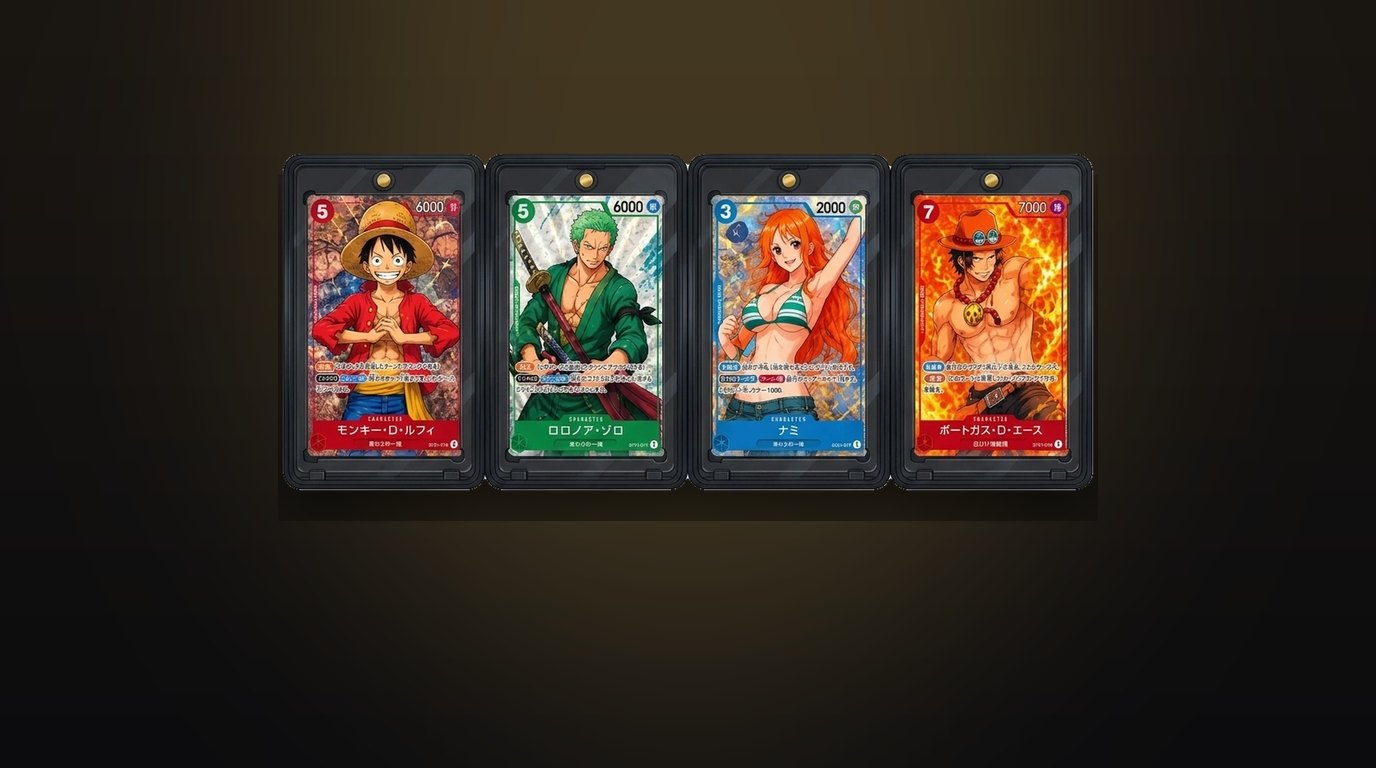
The third reason is aesthetic. OP01 introduced the game's first parallel cards, those alternate art versions that became the signature of the One Piece Card Game. For a collector who wants to tell the story of the game on a wall or in a display case, an OP01 parallel is the natural starting point.
Which OP01 cards should you target in Japanese?
Not all OP01 cards are equal. Commons and uncommons mostly matter for play or set completion: there are a lot of them, and belonging to the first set is not enough to give them real collector value. Interest is concentrated in a small number of cards.
Start with the Leaders, especially their parallel versions, then the Super Rares and Secret Rares, along with the parallels of those rarities. The main crew members and the big names of the One Piece world generally attract most of the demand, which makes their rare versions easier to resell and more stable over time. A parallel of a secondary character is still a beautiful card, but it speaks to a smaller audience.
Finally, do not overlook condition and language. A Japanese OP01 card in A condition, well centered, stands clearly apart from a copy marked by play. Condition, more than rarity alone, is often what explains the price gap between two copies of the same card.
| Rarity | Collector interest | Demand | Prioritize if… |
|---|---|---|---|
| C / UC | Low, mostly for completion | Players, completionists | You want the full set |
| R | Moderate | Depends on the character | The character matters to you |
| L (Leader) | Good, first generation of Leaders | Fairly stable | You love iconic Leaders |
| SR / SEC | High | Strong on major characters | You want a centerpiece |
| Parallel (L, SR, SEC) | Highest | Strong and lasting | You are building a display |
Sealed OP01 box or single cards: which makes sense today?
Opening an OP01 box today means paying the rarity premium of sealed product for a random pull. The Japanese box of a first expansion has become a collectible in its own right: its price reflects its scarcity as an unopened box, not the average value of what is inside. Opening it destroys exactly what makes it valuable, with no guarantee of pulling the card you want.
For a collector who wants a specific card, buying singles is almost always the more rational choice. You pick the character, the rarity and the condition, you see what you pay for, and you have no duplicates to resell. That is the whole idea behind our Japanese cards: every card listed is genuinely for sale in Japan and bought to order, with its condition stated.
Sealed OP01 still makes sense for one specific profile: the collector who wants to keep the unopened box as a piece of history over a long horizon, while accepting the risk. If you would rather open Japanese packs, recent sets and preorders on OPCG.Shop give you the thrill of the pull at a far more coherent price.
How do you recognize a genuine Japanese OP01 card and avoid traps?
An older, sought-after card attracts counterfeits and vague listings. The right habit is to check the printed details first, then the real condition, then the seller. None of these checks is complicated, but skipping them can be expensive.
The most common trap is not the obvious fake, it is confusion. The same artwork or the same character can exist in several versions: the original set card, a reprint in a later product, a promo. These versions do not share the same value, and a listing can blur the difference, deliberately or not.
- Check the OP01 code and number printed on the card, as well as the stated rarity.
- Compare the card with reference photos: Japanese text, font, frame, logo.
- Look at the shine on parallel versions: a dull or overly uniform finish should raise a flag.
- Ask for sharp, unfiltered photos of the front, back and corners.
- Be wary of a price well below the market on a sought-after card.
- Favor a seller who states a precise condition and explains where the card comes from.
What condition should you aim for on an OP01 card?
On an older expansion, condition weighs more than on a recent card. OP01 copies have had time to circulate, to be played, traded and stored more or less carefully. A copy that is truly close to mint becomes scarcer, and that scarcity shows in the price.
Japanese shops usually state condition on a simple scale, the one we use for our cards: A, A-, B and C. For a display piece or a card you might resell one day, aim for A or A-. For a card you simply love for its character, B condition can be an excellent compromise as long as the wear stays discreet.
If you are considering grading, only A condition really justifies the effort: a card that already shows visible wear is unlikely to earn a grade that covers the costs.
| Condition | Description | Best use | Resale |
|---|---|---|---|
| A | Close to mint | Display, centerpiece, possible grading | Easiest |
| A- | Very good | Display, demanding collection | Good |
| B | Good, visible wear | Personal collection, controlled budget | Slower |
| C | Fair | Set completion, playing card | Difficult |
How should you display and store an OP01 card?
A card from the first expansion deserves to be seen, but it does not cope well with direct light, humidity and repeated handling. The right method comes down to three steps: slide it into a sleeve as soon as it arrives, place it in a rigid, closed holder, then display it away from sunlight.
Our magnetic one-touch frame in aluminum, with double glazing, was designed for exactly that. It comes in black or white at €24.80 each, and when you buy 2 frames the 3rd is free. The frames snap together face to back to stack, stand upright like books on a shelf, and attach side by side on the wall with an adhesive magnetic strip, no drilling required.
For an OP01 collection, one simple idea works well: line up the Leaders or parallels from the first expansion on a single row and make that wall the origin story of your collection. If your card is already PSA graded, the slab-compatible version at €34.80 shows it off without taking it out of its case.
OP01 Romance Dawn remains a benchmark because it came first, it introduced parallels and its supply is no longer replenished. But its value is concentrated in Leaders, Super Rares, Secret Rares and above all the parallels of major characters in good condition. Your concrete next step: choose the character that matters to you, check the OP01 code and the stated condition, then buy the Japanese card as a single rather than paying sealed box prices for an uncertain pull. Shipping is €4.20, free from €30.
Frequently asked questions
What is the OP01 expansion of the One Piece Card Game?
OP01 Romance Dawn is the first expansion of the One Piece Card Game, released first in Japan. Its cards carry a code starting with OP01. It laid the foundations of the game and introduced its first parallel cards.
Do all OP01 cards gain value?
No. Commons and uncommons remain affordable, even in Japanese. Collector interest is concentrated in Leaders, SRs, SECs and their parallel versions in good condition, and no increase is ever guaranteed.
Should you open an OP01 box today?
Rarely. The price of a sealed box reflects its scarcity as an unopened product, and opening it destroys that value without guaranteeing the card you want. For a specific card, buying the single is safer.
How can you tell an OP01 card from a reprint?
Check the code printed on the card: it must start with OP01. The same artwork can reappear in other products under a different code. If in doubt, compare with reference photos and ask the seller for sharp pictures.
Read next
Sets and releases
One Piece Card Game Japan release schedule: how to read it and plan ahead
One Piece Card Game Japan release schedule: how to read it, how far ahead of Europe Japan runs, when to preorder and what reprints change.
November 13, 2026
Sets and releases
EB01 Memorial Collection: the cards that matter and how to buy them
EB01 Memorial Collection: what makes this set different, which rarities to target and why buying singles is usually the smartest move.
November 13, 2026
Sets and releases
EB02 One Piece: the most wanted cards and how to buy them right
EB02 One Piece: which Japanese cards to target (SEC, parallels, SP), how to identify them, and why buying singles is usually the safest route.
November 13, 2026