
Starter deck One Piece ST: which decks really matter for collectors
Published on November 13, 2026 · 8 min read

Key points
- A One Piece starter deck (ST code) is a preconstructed deck with fixed contents: one leader, a set card list and DON!! cards, with no random pulls.
- For collectors, the starter decks that matter meet at least two of three criteria: a highly sought-after character as leader, an early generation and a copy that is still sealed.
- An opened starter deck is usually worth the sum of its few playable or iconic cards; kept sealed, it becomes a collectible whose supply shrinks over time.
- Cards from a starter deck carry a code beginning with ST plus the deck number, which sets them apart from booster cards (OP, EB, PRB) and promos (P).
You keep seeing listings for ST01, ST10 or ST20 and wonder which ones deserve a spot in your collection and which are simply beginner decks meant to be opened and played. It is a fair question: the Japanese One Piece Card Game now counts dozens of starter decks, from ST01 to ST36 in our database, and they are far from equal in the eyes of a collector.
The short answer: a starter deck matters for a collection when it features a highly sought-after character, belongs to the early generations and is still sealed. The rest are excellent entry points for playing, but their value often comes down to a handful of cards. Here is how to read the ST range, sort the decks worth keeping and choose between a sealed deck, single cards or a display.
What exactly is a One Piece ST starter deck?
A starter deck, identified by the ST code, is a preconstructed deck sold ready to play. Unlike a booster, its contents are fixed: you know in advance which leader and which cards are in the box. It brings together a leader, a card list designed to work as a whole and DON!! cards, so you can start a game the moment you open it.
That lack of randomness changes everything for a collector. In a booster, value comes from rarity and luck: an SR, a SEC, a parallel card. In a starter deck there is no pull, so there is no hidden big hit. Collector interest comes from elsewhere: the featured character, the leader artwork, the age of the deck and whether it is still sealed.
This is also why starter decks are often underrated. They are the gateway for new players, sell in large numbers at release, then slowly vanish from the shelves. Copies that stayed sealed become harder to find, especially for the earliest numbers.
| Criterion | Starter deck (ST) | Booster | Japanese display |
|---|---|---|---|
| Contents | Fixed, known in advance | Random, 6 cards | 24 boosters of 6 cards |
| Leader included | Yes | Depends on the pull | Depends on the pulls |
| Element of chance | None | High | High, smoothed over 24 boosters |
| Collector interest | Character, age, sealed condition | Rarities and parallels | Sealed, long horizon |
| Best for | Beginners, fans of a character | Curious players | Collectors, bulk opening |
How do you read the codes ST01 to ST36?
ST numbering is chronological: ST01 is the very first starter deck in the game, and each new number marks a more recent release. Our Japanese database currently covers ST01 to ST36. As with booster sets, starter decks are released in Japan first and reach the English version later.
Every starter deck card carries a code such as ST01-001: the letters and first number give the source deck, the second number the card's position in the list. This code is your best tool to identify a card seen in a photo, confirm it comes from a starter deck and tell it apart from a booster card (OP, EB or PRB codes) or a promo (P code).
Also keep in mind that the same character can exist under several codes: featured in a starter deck, it may have another version with different artwork in a booster set. For collecting, what counts is the exact version, meaning the full code.
- ST plus two digits: the starter deck number, in release order.
- The number after the hyphen: the card's position in the deck list.
- The leader has the L rarity, other cards the rarity printed on them.
- An OP, EB, PRB or P code means a booster card or a promo, not a starter deck.
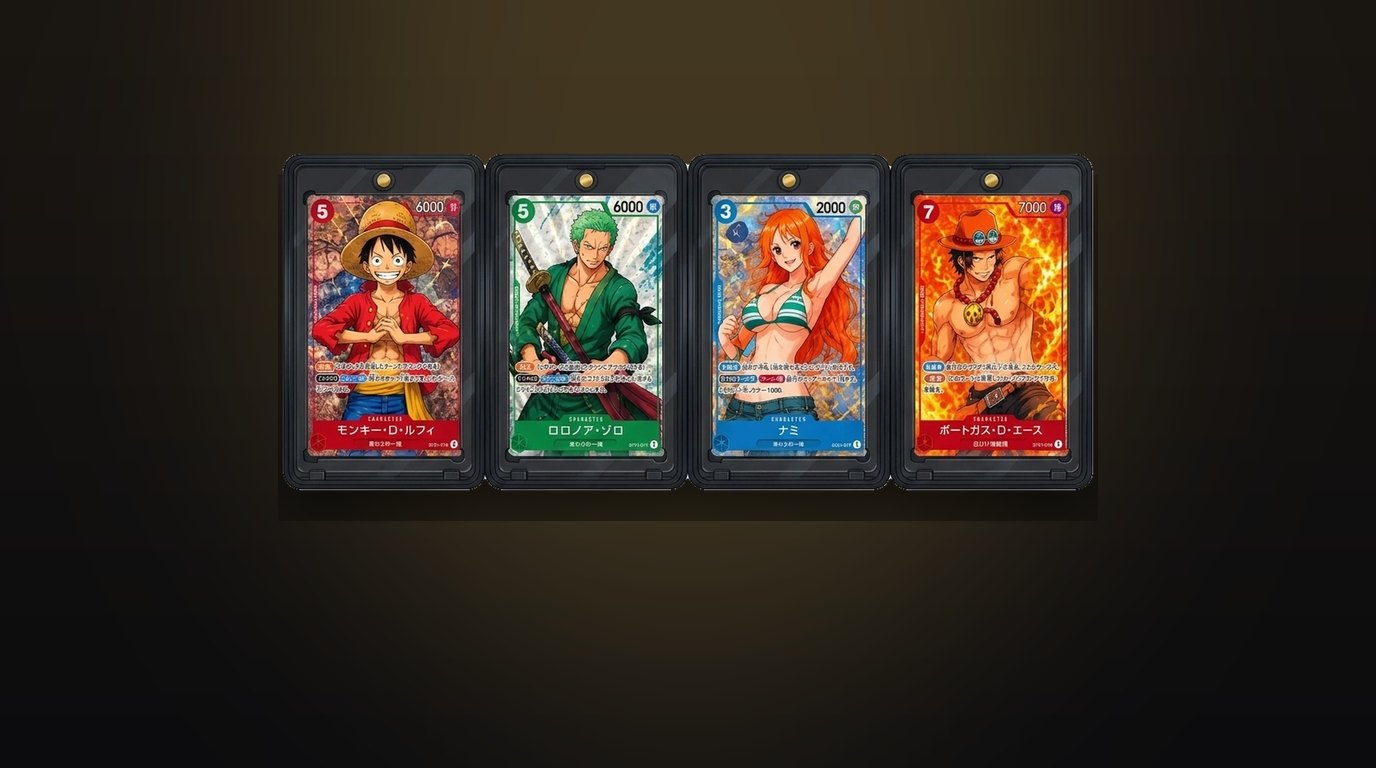
Which ST starter decks really matter for a collection?
Not all starter decks are equal to a collector. Our view is clear: an ST deck is worth keeping when it ticks at least two of the criteria below. If it ticks none, open it, play it and keep only the cards you like.
The first criterion is the character. Decks built around the most sought-after figures of the saga, Luffy and the Straw Hat crew, the Emperors, the great rivals, enjoy steadier demand than decks focused on secondary characters. The second is age: the first generations, starting with ST01, were produced when the game was less widespread, and their sealed copies circulate less.
The third criterion is condition. A starter deck only has real collector value when sealed, with clean packaging. Finally, check whether the deck offers a leader or artwork found nowhere else: that detail is often what keeps a deck in demand years after release.
- A major character as leader: Luffy, the Emperors, iconic figures.
- An early generation, the first ST numbers above all.
- A sealed copy, packaging free of dents and tears.
- A leader or artwork unique to the deck, absent from booster sets.
- A Japanese version, the game's original language.

Should you keep a starter deck sealed or open it?
An opened starter deck is usually worth the sum of its interesting cards: often the leader plus a handful of cards used competitively or loved for their artwork. The rest resells poorly as singles. Sealed, on the other hand, the deck stays a complete object whose supply can only shrink, since every opening removes a copy from the market.
That said, keeping it sealed is no guarantee. Some starter decks get reprinted, or their cards reappear in other products, which limits scarcity. And an old deck built around a character with little demand can sit unsold for a long time. Think like a collector, not a speculator: keep what you love, over a long horizon, without counting on a gain.
A simple strategy works well: buy two copies of the decks you care about, open one to play or display the leader, and keep the other sealed. You enjoy the deck without giving up the collector piece.

Japanese or English starter deck: which one for a collection?
For a collector, the Japanese version has two strengths. It comes out first, since the game is designed and published in Japan, and it is the cards' original language, the one many European collectors look for because of print quality and consistency with the source material. A collection kept entirely in Japanese looks and holds up better than a mix of languages.
The English version still makes sense if you mainly want to play in local tournaments that require it, or if reading effects directly matters to you. But to display a leader or keep a deck sealed, Japanese is our recommendation. Effects are easy to look up thanks to the card code, which is the same across languages.
On budget, always compare the final price including shipping. For our Japanese single cards and frames, shipping is 4.20 € and free from 30 €; for sealed products it is 6.90 € and free from 199 €, paid only once per order.
Starter deck, single cards or display: where should you start?
It all depends on your goal. If you want to learn the game, the starter deck is unbeatable: fixed contents, a coherent deck, a game ready as soon as you open it. If you are after a specific card, a starter deck leader or a booster rarity, buying singles makes more sense: you pay for exactly what you want, in the condition you choose (A, A-, B or C), without buying the rest of the deck.
If you want the thrill of opening packs and a set's rarities, look at a display. Starter decks have no random SR, SEC or parallels; displays do. Many collectors follow this path: a starter deck to discover the game, then a display of the latest set. The Japanese OP18 Display, for instance, is on preorder at OPCG.Shop for 129 €, paid in full and fully refunded if the product does not reach us.
There is no wrong choice, only choices that do not match your intent. Just avoid buying a starter deck hoping to find a hidden valuable card: that is not what it is for.
Pre-order
OP18 booster display (Japanese)
129,00 €
View the productHow should you store and display starter deck cards?
A sealed starter deck should be stored upright, away from direct light, humidity and temperature swings, with nothing stacked on top that could crush the packaging. A box or a closed shelf is enough; what matters is avoiding dings on the corners.
For opened cards, the rule is the same as for any valuable card: a sleeve as soon as it leaves the deck, then rigid protection for the pieces you keep. A starter deck leader, often the best looking card in the box, deserves to be on display. Our aluminium one-touch magnetic frame, double glazed, in black or white, costs 24.80 € each, with the 3rd free when you buy 2.
The frames snap together face to back to stack, stand upright like books, or sit side by side on the wall with an adhesive magnetic strip (1 m for 15 €, 3 m for 29 €), no drilling needed. A row of ST leaders, from the first deck to the latest, makes a clear and coherent collection wall.
- Slip every card you keep into a sleeve as soon as you open the deck.
- Put leaders and favourite cards in a rigid frame.
- Store sealed decks upright, away from light and humidity.
- Note the ST code and condition of each piece to track your collection.

Our verdict: a One Piece ST starter deck matters for a collection when it combines at least two of these: a major character, an early generation and sealed condition; the others are excellent decks to play, from which you keep the leader and a few cards. Your next concrete step: list the characters you love, find the matching ST codes, keep sealed those that meet at least two criteria and display the leaders of those you open. For random rarities, move on to a display of the latest set at OPCG.Shop.
Frequently asked questions
What is inside a Japanese One Piece starter deck?
A starter deck holds a preconstructed, ready to play deck: one leader, a fixed card list designed to work together and DON!! cards. The contents are known in advance, with no random pulls as in a booster.
What was the first One Piece starter deck?
The first is ST01, which opens the starter deck numbering. As with all early generations, its sealed copies are generally more sought after than those of recent decks in the same condition.
Can a One Piece starter deck go up in value?
Some can, especially sealed, older decks built around a popular character, but nothing is guaranteed. Reprints and weak demand for some characters can cap any rise. Buy what you love first, with a long horizon.
How can I tell if a card comes from a starter deck?
Check its code: a starter deck card begins with ST followed by the deck number, for example ST01. Booster cards carry an OP, EB or PRB code, and promos a P code.
Read next

Sets and releases
One Piece Card Game Japan release schedule: how to read it and plan ahead
One Piece Card Game Japan release schedule: how to read it, how far ahead of Europe Japan runs, when to preorder and what reprints change.
November 13, 2026

Sets and releases
EB01 Memorial Collection: the cards that matter and how to buy them
EB01 Memorial Collection: what makes this set different, which rarities to target and why buying singles is usually the smartest move.
November 13, 2026

Sets and releases
EB02 One Piece: the most wanted cards and how to buy them right
EB02 One Piece: which Japanese cards to target (SEC, parallels, SP), how to identify them, and why buying singles is usually the safest route.
November 13, 2026