Selling One Piece cards: prepare, price and pick the right channel
How to sell your One Piece cards for a fair price: sort the lot, price from completed sales and match each card to the right sales channel.
Published on November 13, 20267 min read

Key points
- To sell One Piece cards well, sort first: a collection's value usually sits in a small minority of cards (SR, SEC, parallels, manga rares, alternate leaders), and only those deserve individual listings.
- The resale price of a One Piece card is estimated from recent completed sales of the same version, language and condition, never from current asking prices.
- Japanese and English One Piece cards trade in separate markets: never price one against the other, and always state the language clearly in every listing.
- The right sales channel depends on value: individual sales between collectors for strong cards, playsets or lots for playable cards, and shop buylists for bulk when speed matters most.
Your One Piece binder keeps growing, duplicates are piling up, or you want to fund the one card missing from your display. The question is simple: how do you sell your One Piece cards without underselling them or spending weeks on it? The classic mistake is listing the whole binder at once, copying the highest asking price you can find, and then waiting for buyers who never show up.
Our answer comes in three steps. Sort the collection to isolate the few cards that carry the value, price each one from completed sales and its real condition, then choose the channel by value: individual sales for strong cards, lots or playsets for playable cards, a shop buylist when speed matters more than price. Here is the method, criterion by criterion, plus the habits that prevent disputes.
In this article
- 1. Where do you start when selling One Piece cards?
- 2. How do you price a One Piece card for resale?
- 3. How should you prepare and photograph cards before selling?
- 4. Which channel should you use to sell One Piece cards?
- 5. Should you sell singles, lots or playsets?
- 6. How do you ship a sold card without disputes?
- 7. Should you sell everything or keep your centrepieces?
Where do you start when selling One Piece cards?

Start with sorting, not listing. In a typical collection, most of the value sits in a small minority of cards: SR, SEC, parallels, manga rares, alternate leaders and some sought-after promos. Commons and uncommons, however many you have, are worth little once platform fees and postage are deducted, and they rarely justify a listing of their own.
Make three piles. The first holds the cards worth selling individually with careful photos. The second gathers playable cards that players actually want, to be offered as coherent lots or as four-copy playsets. The third is bulk, sold as one big lot or given to a local club to help new players get into the game.
For every card in the first pile, note the printed code (set and number, for example OP05 followed by the card number), rarity, language and condition. This small inventory, done once, saves a lot of time when setting prices and answering buyers, who almost always ask for those four details before committing.
- Pile 1: SR, SEC, parallels, manga rares, alternate leaders, sought-after promos, sold individually
- Pile 2: playable cards from the current format, sold as playsets or colour lots
- Pile 3: commons, uncommons and unwanted duplicates, sold as bulk or given away
- For each pile 1 card: code, rarity, language, condition
How do you price a One Piece card for resale?
An asking price is not a price, it is a wish. To estimate, look at recent completed sales of the same card, in the same version, language and comparable condition. Work with a range rather than a single figure, and ignore extreme sales, which often reflect a rushed buyer, a poorly watched auction or a misdescribed item.
Three factors move the price a lot. Version first: a parallel and the base version of the same character are different products. Language next: a Japanese card and its English counterpart trade in separate markets, so never compare one with the other. Condition last: a whitened corner, a slight bend or a scratch on the holo surface is enough to push a card out of the top of the range.
Think in net terms as well. Between platform fees, tracked postage and protection, what you actually receive is lower than the displayed price. Work out that net figure before listing: it tells you whether a card deserves its own listing or should join a lot. Our article on One Piece card values walks through this reading of the market.
How should you prepare and photograph cards before selling?

A well-presented card sells faster and gets haggled less. Handle valuable cards with clean, dry hands on a soft surface, and slide them into a fresh sleeve as soon as they leave the binder. Never clean a card with any product: a dry microfibre cloth is enough for dust, and anything else risks leaving permanent marks.
Photograph every important card front and back, in indirect daylight, without flash, on a neutral background. Add close-ups of the corners and edges, then an angled shot that reveals any scratches on the glossy surface. These are exactly the flaws buyers look for, and showing them upfront prevents most disputes.
Describe condition honestly, in plain words: near mint, very good, good with visible wear, fair. Japanese shops use a similar scale (A, A-, B, C) that experienced buyers know well. Grading your card slightly below reality always pays better than a disappointed buyer asking for a return.
- Fresh sleeve as soon as the card leaves the binder
- Front and back photos, daylight, no flash
- Close-ups of all four corners and edges
- Angled shot to reveal scratches
- Sober, verifiable condition description
Which channel should you use to sell One Piece cards?
There is no single best channel, only a channel suited to each pile. Listings between private sellers, on a card-focused marketplace or a general classifieds site, usually get the best price for strong cards, at the cost of your time: writing listings, answering questions, preparing parcels.
Selling to a shop or game store is the fastest option, but the offer includes the store's margin and risk, so it is logically lower. Conventions and local tournaments let you sell in person, with no postage, to players who know what they want. Collector groups work well for trades and sales between people who trust each other.
For most sellers, the winning mix is simple: strong cards online, one by one; playable cards as lots at a tournament or online; bulk as a single lot or to a shop. Do not spend an hour selling a card that will earn you less than the cost of posting it.
| Channel | Price achieved | Speed | Effort | Best for |
|---|---|---|---|---|
| Private listings | Usually the highest | Variable | High (photos, shipping, questions) | Strong single cards |
| Card-focused marketplace | High, minus fees | Good | Medium | Sought-after cards, playsets |
| Shop buylist | Lower | Immediate | Low | Bulk, large lots, quick cash |
| Convention, local tournament | Fair to good | Same day | Medium (being there) | Playable cards, lots |
| Collector group | Good | Variable | Medium | Trades, trusted sales |
Should you sell singles, lots or playsets?
The rule is economic first: a card deserves a single listing if its net price, after fees and postage, justifies the time spent. Below that threshold, which you set yourself, group cards together. A coherent lot often sells better than a pile of isolated cards with no individual appeal that sit online for months.
For players, think in playsets: four copies of the same playable card is what a deck uses and what buyers search for. Colour or leader lots also work well, because they save the buyer from building a deck piece by piece. For collectors, a themed lot around a character, an arc or a set draws more interest than a random mix.
Sealed products follow a different logic: an intact Japanese display or booster sells as a whole. Opening it to sell the contents individually is a gamble, not a method, since the value of the pulls is unpredictable and the sealed value disappears the moment it is opened.
How do you ship a sold card without disputes?

Shipping is where a good sale can turn into a dispute. A valuable card always travels sleeved, in a toploader or rigid case, held between two pieces of card in a padded envelope. For the most expensive cards, use tracked shipping, plus insurance matched to the value if your carrier offers it.
Photograph the packed card before sealing the envelope, then keep the proof of postage and the tracking number until delivery is confirmed. Those two pieces of evidence settle the vast majority of claims. For shipments outside your country, check customs formalities: a sold card is still goods.
On the tax side, occasionally selling personal belongings and regularly buying to resell are not treated the same way in every country. If you sell often and in volume, check with your national tax authority: it is a matter of method, not a detail.
- Sleeve, then toploader or rigid case
- Card held between two pieces of card, padded envelope
- Tracked shipping for valuable cards
- Photo of the parcel before sealing
- Proof of postage and tracking kept until delivery
Should you sell everything or keep your centrepieces?
Selling does not mean liquidating. Many collectors regret parting with the card that got them into the game, while they never miss their bulk. Before listing, ask one simple question for each strong card: would I buy it back at the price I am selling it for? If the answer is yes, keep it.
Reselling is often a way to refocus a collection: you sell duplicates and cards you have no attachment to, in order to fund one Japanese card you truly want. That is usually more satisfying than a binder full of average cards. Our Japanese single cards, bought in Japan to order, let you target the exact version you are missing without going back to boosters.
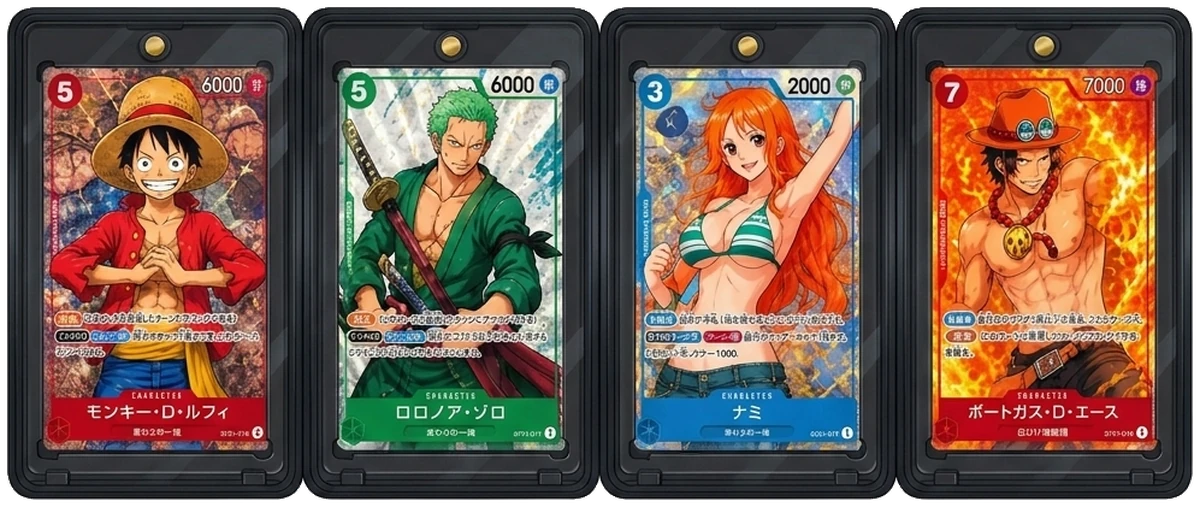
The cards you keep deserve to be protected and seen. Our aluminium magnetic frame, with a double pane, shields the card from dust and handling while displaying it on a shelf or on the wall. A well-kept card is also the one that will sell best on the day you change your mind.
To sell your One Piece cards at a fair price, sort before you list, price from completed sales of the same version, language and condition, then match the channel: single listings for strong cards, playsets or lots for playable cards, bulk or a shop buylist for the rest. Take care with photos and shipping, because that is where trust is won and disputes are avoided. Your next step: inventory your first pile, then reinvest the proceeds in the Japanese card your collection is really missing.
Frequently asked questions
Where can I sell One Piece cards for the best price?
Individual sales between private buyers, online or at conventions, usually get the best price for strong cards. Shop buylists are faster but lower, since they include the store's margin. The right channel therefore depends on each card's value and the time you want to invest.
Do Japanese One Piece cards resell well in Europe?
Yes, they have their own collector audience, drawn by the print quality and the earlier releases in Japan. Their market is separate from English cards, so price them only against sales of Japanese cards and always state the language in the listing.
Should I get a card graded before selling it?
Only if its value justifies the cost, the waiting time and the risk of a disappointing grade. For the vast majority of cards, a raw sale with detailed photos and an honest condition description remains the most profitable option.
How do I avoid scams when selling cards?
Stick to platforms that handle payment, ship only after the funds have actually arrived, and refuse requests to pay outside the platform. Use tracked shipping, photograph the parcel before sealing it and keep the proof until delivery is confirmed.
Read next
 Value and investing
Insuring a card collection: protect and cover your valuable One Piece cards
November 13, 20267 min read
Home insurance, scheduled valuables, inventory and protection: the method to insure a trading card collection without nasty surprises.
 Value and investing
One Piece anniversary card value: lasting collectible or passing trend?
November 13, 20267 min read
One Piece anniversary cards: what keeps their value, what is just hype, and how to buy the Japanese version at the right moment.
 Value and investing
One Piece card ex leader value: rarity and worth of parallel leaders
November 13, 20267 min read
Parallel One Piece leaders: what really drives their value, how to check the version and which condition to target before buying Japanese.