
PSA One Piece value: does grading really raise a card's price?
Published on November 13, 2026 · 7 min read

Key points
- PSA grading does not automatically raise the value of a One Piece card. It certifies condition, and the market mainly pays a premium for a PSA 10.
- A modern One Piece card graded PSA 9 or lower often sells for barely more than a raw card in good condition. Once grading costs are counted, it can be worth less.
- Grading a One Piece card only makes sense if the card is already in demand (SEC, SP, manga rare, parallel of a popular leader) and its centering, corners, edges and surface look flawless under a loupe.
- To own a PSA 10 One Piece card without risk, buying a slab that is already graded rules out a disappointing grade. A raw Japanese card in A condition can be protected and displayed very well in a rigid one-touch frame.
You own a beautiful Japanese One Piece card: a Luffy parallel, a SEC or a manga rare. Everywhere you look, PSA 10 listings sit well above the price of the same raw card. The question is fair: should you send it for grading to raise its value, or is that just one more expense that will never pay off?
The short answer: PSA grading only adds value when the card gets the top grade, or very close to it, and only if the card is already in demand. In every other case, it costs more than it returns. Here is how to check this card by card before you send anything, and what is often the smarter move instead.
What does a PSA grade really change about a One Piece card's value?
PSA is an American company that authenticates a card, rates its condition on a scale from 1 to 10, then seals it in a hard case called a slab. The slab carries a label with the grade and a certification number. PSA creates no new scarcity: it turns a subjective condition such as near mint into a grade that any buyer in the world can read.
That is where the added value comes from. A buyer who cannot see the card in hand will pay more for a verifiable grade than for a photo. But that trust only commands real money at the top of the scale. A PSA 10 (Gem Mint) means a copy with no visible flaw, and a PSA 9 (Mint) means an excellent copy with one small flaw. Below that, the grade almost becomes an argument against the card.
The market therefore reads the grade as a filter. For a modern card printed in large numbers, what matters is not being graded but being one of the perfect copies. The table below sums up the general trend for recent cards. It gives no figures, because the gap varies a lot from one card and one period to another.
| Condition | Effect on value | Ease of resale | Best for |
|---|---|---|---|
| Raw, A condition | Serves as the market reference | Good, but the buyer has to trust photos | Collectors who display or play |
| PSA 10 | Clear premium, sometimes very large on a sought-after card | Very good, the grade speaks for itself | Demanding collectors, resale |
| PSA 9 | Often close to raw, sometimes slightly above | Average | Tight budgets that want a slab |
| PSA 8 and below | Often below raw once fees are included | Weak | Rarely worth it for a modern card |

Why does the premium concentrate on PSA 10?
Because modern One Piece cards leave the factory in good condition in the vast majority of cases. A card pulled from a fresh booster and sleeved right away is often already near mint. A 9 is therefore nothing exceptional: it describes what many collectors already own without paying anything extra.
A 10, on the other hand, stays uncertain even for a card that looks spotless. Slightly off centering, a micro scratch on the holo surface or one corner that is a little less sharp is enough to miss it. That uncertainty is what creates the premium: a PSA 10 buyer pays for the guarantee that someone else took the risk and won.
PSA also publishes a population report showing how many copies of a card received each grade. The more PSA 10 copies a card has, the more its premium tends to shrink. So a grade has no fixed value: it depends on how rare that grade is, for that card, at a given moment.
Which One Piece cards are worth grading?
The rule is simple: grading adds value to a card that already has some. A common or a basic rare graded 10 is still a card few people want, locked in a case that cost more than the card itself. A card that many collectors are hunting, however, can see its price clearly supported by a perfect grade.
The natural candidates are rare, in-demand cards: SEC, SP, manga rares, parallels of popular leaders and some promos (P) with limited distribution. These are the cards buyers look for in slabs, because they change hands often and certified condition is reassuring when the amounts get high.
After that, the individual copy decides, not the card model. Before sending anything, inspect the card under a raking light and a loupe, checking the four criteria graders look at. If even one of these points gives you doubts, a 10 is unlikely.
- Centering: borders of similar width left and right, top and bottom, on both front and back.
- Corners: four sharp corners, with no whitening and no dents.
- Edges: no white marks or chipping along the edges, especially on the back.
- Surface: no scratches, fingerprints, print lines or dents visible under angled light.
Is a Japanese card graded the same way as an English one?
Yes. PSA grades Japanese One Piece cards on the same scale, and the label usually states the set and the language. Many European collectors actively look for graded Japanese versions, because sets release in Japan first and Japanese printing has its own following.
The trap lies elsewhere: the condition a Japanese shop announces is not a PSA grade. A condition means near mint in a seller's eyes, which guarantees neither perfect centering nor a surface free of micro scratches. Our Japanese cards are listed as A, A-, B or C depending on the source shop. That is an excellent guide when buying, not a promise of a 10.
Cards with holographic or textured surfaces, common among parallels and SEC, need special care. They mark easily, and their flaws often only show under raking light. The only reliable method is to receive the card, inspect it yourself, then decide whether it goes off for grading.

How much does PSA grading really cost?
PSA's fee is only the starting point. It depends on the service level you choose and on the declared value of the card, and it changes regularly, so always check the current price list on the official website before sending a card. From Europe, several often forgotten costs come on top.
The least visible cost is time. Depending on the service level, a card can be away for several weeks or even several months, and its market price can move either way in the meantime. Nothing guarantees the grade you hope for either: a card that comes back as an 8 cost exactly as much as one that comes back as a 10.
So run the numbers before you send anything. Add up all these costs, then compare the likely PSA 9 value, the cautious scenario, to the card's raw value. If a PSA 9 does not cover the costs, grading only makes sense if you are truly confident about a 10, or if you want the slab for yourself.
- PSA service fees, depending on the service level and declared value.
- Tracked and insured outbound shipping, in rigid packaging.
- Possible middleman fees if you use a group submission service.
- Insured return and, depending on the case, import taxes or fees on arrival.
- The card is tied up during processing, with the risk of a lower grade than expected.

Grade it, keep it raw or buy it already graded?
It all depends on your goal. If you plan to resell a highly sought-after card one day, a PSA 10 is the condition that resells most easily. If you simply want to own and display a beautiful card, a raw A condition copy often gives the best balance between looks and price, with no fees and no waiting.
A third route is often more rational: buying a card that is already graded. You pay the premium for the 10, but you know exactly what you are getting, with no risk of a disappointing grade. For a collector who only grades one or two cards, this is often cheaper than trying your luck.
Finally, remember that a graded card's value follows the value of the card itself. If interest in a character or a set fades, the slab does not protect the price. Grading certifies condition, it does not protect you from the market: think in terms of risk and method, never guaranteed returns.
| Option | Total cost | Risk | Best for |
|---|---|---|---|
| Keep it raw (A condition) | The card price only | Low, condition must be preserved | Display, play, personal collection |
| Grade it yourself | Card, PSA fees, shipping and waiting | Uncertain grade | Sought-after card and flawless copy |
| Buy it already graded | Slab price, premium included | None on the grade, price to check | Aiming for a PSA 10 without betting |
How do you protect and display a card, graded or raw?
A graded card is protected by its slab, but the slab is still vulnerable to direct light and knocks: a scratched or cracked case resells less well. A raw card should go into a sleeve as soon as it arrives, then into a rigid holder, to keep its A condition and, with it, its chances if you grade it later.
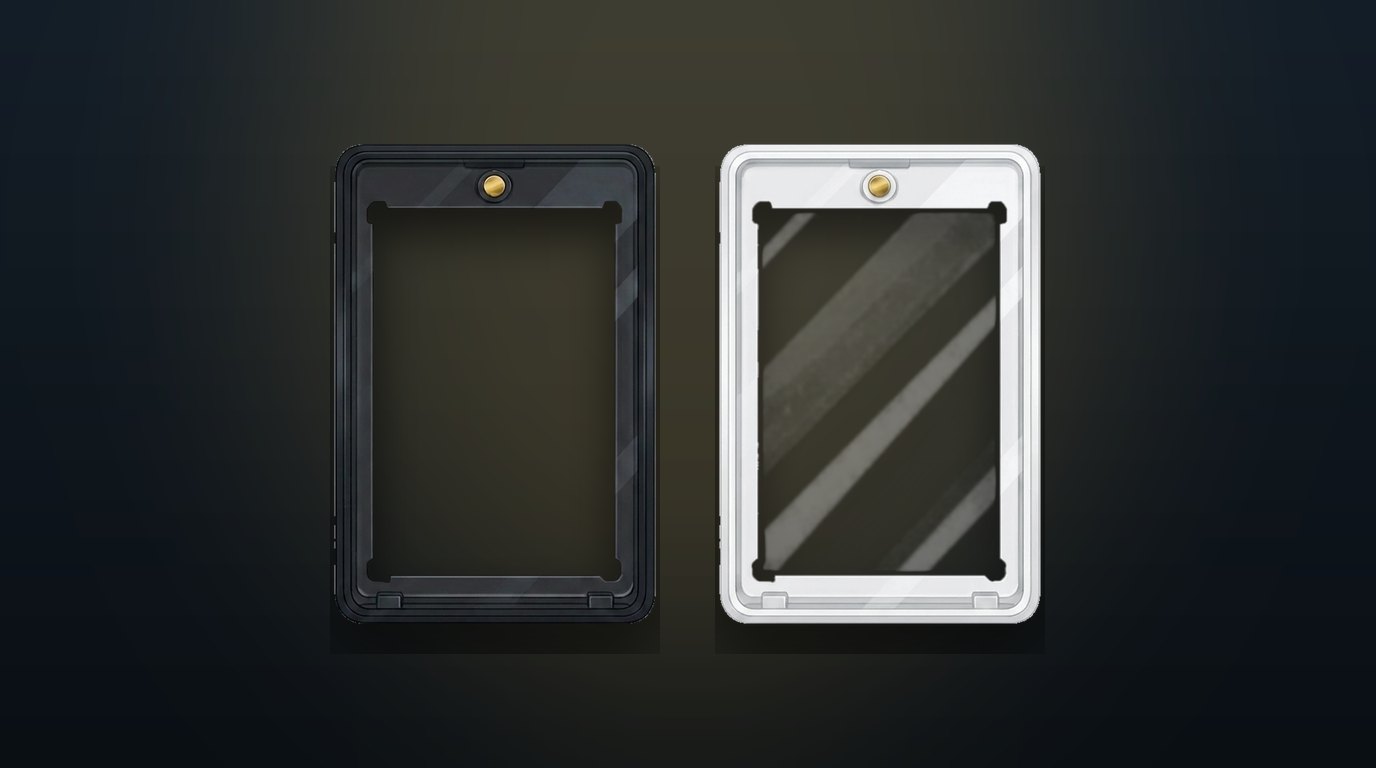
Our aluminium one-touch magnetic frame, with double glazing, in black or white, protects a sleeved raw card for 24.80 € each, and the third one is free when you buy two. For a slab, the PSA compatible version costs 34.80 € (frame sold empty). The frames snap together face to back to stack and stand upright like books. They can also be mounted on the wall without drilling, using the adhesive magnetic strip.
Displaying a card does not cost it value as long as it stays away from direct UV light, humidity and repeated handling. It is actually the best way to enjoy a beautiful piece without taking it out of its protection, whether or not you ever have it graded.
The verdict: PSA grading only raises the value of a One Piece card when three conditions are met. The card is already in demand, the copy is flawless, and a PSA 9 would at least cover the costs. Otherwise, keep the card raw or buy a slab that is already graded. Your next step: inspect your card with a loupe under raking light, check its population report and add up every cost. While you decide, keep it sleeved in a rigid frame to preserve its condition.
Frequently asked questions
Is a PSA 10 One Piece card always worth more than a raw one?
For a sought-after card, usually yes, and the gap can be large. For a card with little demand, the premium stays small and sometimes does not even cover the grading costs. A grade adds value to a card that already has some.
Does PSA grade Japanese One Piece cards?
Yes, PSA grades Japanese One Piece cards on the same 1 to 10 scale as other cards. The label usually states the set and the language, which tells a Japanese version apart from an English one.
Will a card in A condition get a PSA 10?
Not necessarily. A condition from a Japanese shop means near mint to the eye, while a PSA 10 also requires nearly perfect centering and surface. Inspect the card yourself under raking light before you decide.
Is it better to grade a card or buy one already graded?
If you only have one or two cards to grade, buying a slab that is already graded is often safer: you pay the premium, but with no risk of a disappointing grade. Grading it yourself mainly makes sense for a sought-after card whose copy looks flawless.
Read next
Value and investing
Insuring a card collection: protect and cover your valuable One Piece cards
Home insurance, scheduled valuables, inventory and protection: the method to insure a trading card collection without nasty surprises.
November 13, 2026

Value and investing
One Piece anniversary card value: lasting collectible or passing trend?
One Piece anniversary cards: what keeps their value, what is just hype, and how to buy the Japanese version at the right moment.
November 13, 2026
Value and investing
One Piece card ex leader value: rarity and worth of parallel leaders
Parallel One Piece leaders: what really drives their value, how to check the version and which condition to target before buying Japanese.
November 13, 2026