
OP17 One Piece: the collector pieces and the right time to buy
Published on November 13, 2026 · 7 min read

Key points
- In OP17, as in every Japanese One Piece set, the collector pieces are concentrated in the special treatments: parallel leaders, parallel SRs, SECs and SP cards.
- The single price of a rare OP17 card is often at its highest in the days following the Japanese release, then usually settles once supply builds up.
- To get a specific OP17 card, buying the single is almost always safer than opening boosters, because a Japanese display of 24 boosters guarantees no particular card.
- An OP17 piece meant for display should be bought in A or A- condition, sleeved on arrival and shown in a closed frame, away from direct sunlight.
You have seen OP17 cards all over social media, a stunning parallel, a SEC that shows up everywhere, and you are wondering which ones truly deserve a place in your collection. Above all, you do not want to pay top price at the worst moment, when everyone is chasing the same card. It is the question every new Japanese set raises, and OP17 is no exception, especially with OP18 already on preorder and drawing a large share of the attention.
Our answer comes down to two ideas. First, the collector pieces of OP17 sit in the rare treatments (parallel leader, parallel SR, SEC, SP) and on strong characters, not in the mass of commons. Second, the right moment to buy a specific card is rarely release week: it comes after the first peak, as a single, in Japanese. Here is the full method, with checkable criteria and a simple timeline to follow.
What makes a collector piece in OP17?
A Japanese OP set always follows the same rarity structure: C, UC and R for the base, SR for the strong cards, L for leaders, SEC for secret rares, plus parallel or alternate versions that reuse a card with a different artwork, often full art. Some sets also add SP cards. In OP17, the collecting interest lies in these special versions, not in the commons you find by the dozen in every display.
Three criteria then separate two cards of the same rarity. The character first: a central figure of the manga always draws more collectors than a side role. The artwork next: a full art parallel, a striking style or a bold composition stands out in a frame and resells better. Finally, play demand: a leader or a tournament staple keeps buyers beyond the collector circle alone.
Before buying, always check the rarity and exact code on the official set list, because a base version and its parallel share the same number. It is the treatment, not the number, that makes the collector piece.
| Rarity | What it is | Collecting interest | Our view |
|---|---|---|---|
| C, UC, R | Base cards | Low | For playing or completing a set |
| SR | Strong cards, often played | Medium | Worth it if the character is major |
| L (leader) | The card that defines a deck | Medium to high | Go for the parallel version |
| Parallel or alternate | Special artwork of an existing card | High | The heart of an OP17 display |
| SEC, SP | The rarest versions in the set | Very high | Centerpiece, buy it as a single |

Which OP17 cards should you target for your profile?
There is no single list of good OP17 cards: it all depends on what you are after. A character collector, a player and a lover of beautiful artwork will not buy the same card, and that is fine. Start from your goal, then apply the criteria above: rarity, character, artwork, play demand.
The most common trap is buying the card everyone is talking about, at the moment everyone is talking about it, without knowing whether it fits your collection. A beautiful card of a character you do not follow ends up in a binder. A less hyped parallel of your favorite character makes far more sense in a frame, and often costs you less.
- Character collection: the rarest available version of your character in OP17 (parallel, SEC or SP), then the base version to complete it.
- Decorative display: full art parallels whose artwork reads well from a distance and looks great behind glass.
- Player and collector: the parallel leader of your deck, which you can both play and display.
- Tight budget: parallel SRs of secondary characters, often more affordable than SECs while still being real pieces.

When is the best time to buy an OP17 card?
The single price of a Japanese card often follows a fairly readable cycle after the Japanese release. In the first days, supply is thin and demand is at its peak: rare cards are listed at their highest. Then displays get opened, cards reach the market, and prices usually ease over several weeks. This cycle is not a law, but a trend that repeats from set to set.
There are exceptions. A card in high tournament demand or a very popular character can stay high, or even climb once the set is no longer reprinted. A reprint, on the other hand, can pull a card's base price down. That is why it pays to follow the price of a specific card for a few weeks rather than reacting to a single listing or one excited post.
For OP17, the arrival of OP18 matters too: when attention shifts to the new set, cards from the previous one are often less contested. That is frequently a good window to buy your OP17 piece with little competition and in the condition you want.
| Phase | Supply | Rare card prices | Our advice |
|---|---|---|---|
| Release week | Low | Often at their highest | Wait, unless it is love at first sight |
| First weeks | Rising | Usually easing | Watch the card you want |
| Stabilization | Established | More stable | Good window to buy singles |
| Next set release | Plentiful | Less contested | Often the ideal moment |
| Long term | Depends on reprints | Depends on demand | Strong pieces hold up better |
Should you buy OP17 as singles or in boosters?
If your goal is a specific card, singles win almost every time. A Japanese display contains 24 boosters of 6 cards, and nothing guarantees that a given SEC or parallel will come out of it. You can open several boxes without hitting the card you want, then end up buying it anyway. A single removes the gamble: you pay for the card you want, in the condition you chose.
Boosters keep their appeal for the joy of opening, for building a playing base or for anyone who loves surprises. It is a hobby, not an acquisition method. If you enjoy opening, open for fun with a budget set in advance, and buy as singles the cards that truly matter to you.
Our Japanese singles are bought in Japan to order, with the condition stated by the Japanese shop, and shipping costs 4.20 €, free from 30 €. For an OP17 piece, it is the shortest route from wanting a card to holding it.
Which condition should you choose for an OP17 piece?
For a card meant for display, condition matters as much as rarity. Japanese shops grade on four levels: A (near mint), A- (very good), B (good, visible wear) and C (fair). For a SEC, an SP or a parallel you want to display or keep for a long time, aim for A, or A- if the price gap is significant and the described flaws are minor.
B and C conditions have their place for a playing card or a base version you simply want to own. They make a rare card more affordable, but visible wear shows behind glass and weighs on any future resale. On a centerpiece, the initial saving is often paid back later.
A recent card like those from OP17 is usually found in good condition, since it has barely circulated. That is one more reason to buy during the stabilization phase, when A condition supply is plentiful and you can afford to be picky.

How do you protect and display your OP17 cards?
A collector piece should be protected as soon as it arrives. Slide the card into a perfect fit sleeve, then into a closed rigid holder. Avoid direct sunlight, which can fade colors over time, and humidity, which makes cardboard warp. These simple habits preserve the A condition you paid for.
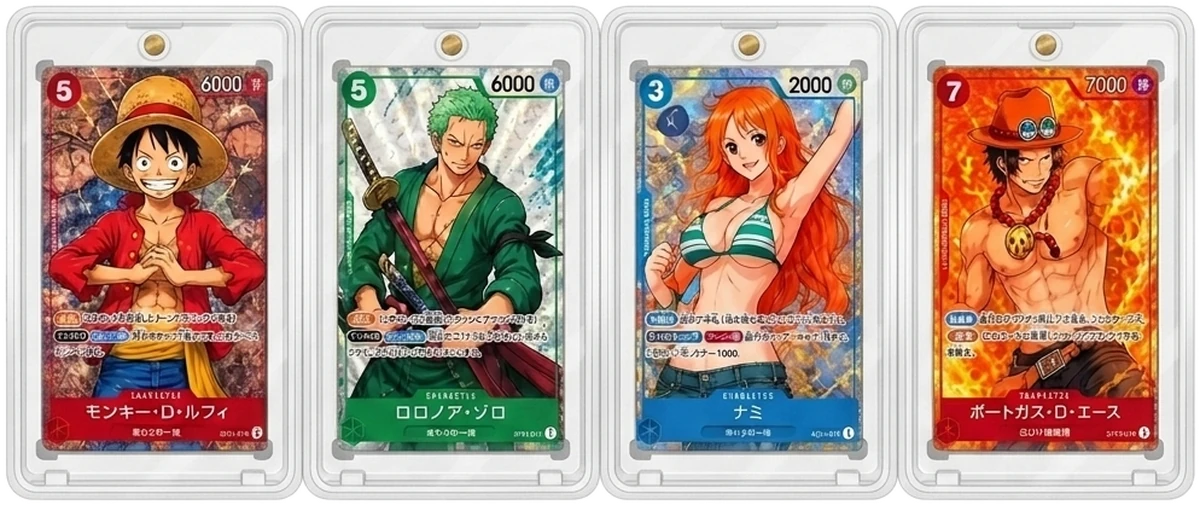
For display, our aluminum one-touch magnetic frame with double glass protects the card while showing it off. It comes in black or white at 24.80 € each, buy two and get the third free. The frames stick face to back to stack, stand upright like books, and line up side by side on the wall with an adhesive magnetic strip, no drilling needed.
For a coherent OP17 series, line up your centerpiece and its supporting cards: three frames side by side already tell the story of a set. White gives a bright look in a light interior, black makes darker artwork pop.
OP17 or OP18: where should your budget go?
With OP18 already on preorder, the budget question comes up. Our view is clear: these are two different purchases. OP17 is played as singles, on identified cards, when prices settle. OP18 is prepared sealed, if you enjoy opening or keeping a display, by reserving early rather than chasing stock on release day.
On OPCG.Shop, the Japanese OP18 display is available at 129 € on preorder. The preorder is paid in full and refunded entirely if the product does not reach us. Shipping for sealed products costs 6.90 €, free from 199 €, and is paid only once per order.
A simple split works well: the OP17 piece you want right now, as a single, and the OP18 display reserved for later. You make the most of the quiet OP17 window without missing the next launch.
Pre-order
OP18 booster display (Japanese)
129,00 €
View the productVerdict: in OP17, the real collector pieces are the rare treatments (parallel leader, parallel SR, SEC, SP) on the characters that matter to you, and the best time to buy them is rarely release week. Wait for prices to settle, often when attention moves to OP18, choose A or A- condition, and buy singles rather than betting on boosters. Your next concrete step: write down the OP17 card you want, follow its price for a few weeks, then order it from our Japanese cards and save it a spot in a frame.
Frequently asked questions
What are the most sought after OP17 cards?
As in every Japanese OP set, they are usually the SECs, the SPs, the parallel leaders and the parallels of major characters. Demand also depends on tournament play. Check the official list and the current price before buying.
Will OP17 card prices go down?
Rare cards are often at their highest on release, then settle as supply grows. It is never guaranteed: a heavily played or very popular card can stay high. Follow the card you want for a few weeks before deciding.
Is it better to collect OP17 in Japanese?
Sets come out in Japan first, and collectors appreciate Japanese cards for their finish. For a display collection, it is often the most accessible choice. If you play in tournaments, check your event's language rules.
Should I buy an OP17 display or singles?
For a specific card, singles are almost always safer, because a display of 24 boosters guarantees no particular card. A display remains a choice for the fun of opening or to keep sealed. Set your budget before you decide.
Read next

Sets and releases
One Piece Card Game Japan release schedule: how to read it and plan ahead
One Piece Card Game Japan release schedule: how to read it, how far ahead of Europe Japan runs, when to preorder and what reprints change.
November 13, 2026

Sets and releases
EB01 Memorial Collection: the cards that matter and how to buy them
EB01 Memorial Collection: what makes this set different, which rarities to target and why buying singles is usually the smartest move.
November 13, 2026

Sets and releases
EB02 One Piece: the most wanted cards and how to buy them right
EB02 One Piece: which Japanese cards to target (SEC, parallels, SP), how to identify them, and why buying singles is usually the safest route.
November 13, 2026