
OP14 One Piece: the standout cards and how to buy them as singles
Published on November 13, 2026 · 7 min read

Key points
- OP14 is the fourteenth main set of the One Piece Card Game. Its cards are identified by the code OP14 followed by a number, printed next to the rarity letter.
- As in every OP set, the standout cards of OP14 are the parallel leaders, parallel SRs, the SEC and the SP cards, plus manga rares whenever the set includes them.
- To get one specific OP14 card, buying it as a single is almost always safer than buying a Japanese display of 24 boosters, where no particular high rarity is guaranteed.
- For an OP14 display piece, aim for condition A or A-. Condition B suits play or tight budgets, provided the price gap is real.
You have seen OP14 cards going around and you are wondering which ones are really worth buying? Most collectors ask the same thing when a new main set lands: dozens of cards, several rarity tiers, parallel versions that look alike, and prices that move in the weeks after the Japanese release. Opening boosters at random gets expensive when you only want one card.
Our answer is clear. For OP14, as for every OP set, the standout cards are the parallel leaders, the SECs, the SPs and, when there are any, the manga rares. The safest way to get them is to buy singles, in Japanese, in condition A or A-. This guide gives you the method: spot the right version, check the condition, choose between singles, boosters and displays, then display the card.
What is OP14 and how do you recognise its cards?
OP14 is the fourteenth main set, part of the OP booster series, of the One Piece Card Game. Like every OP series, it releases in Japan first and in English later. Each card carries a code printed at the bottom, in the form OP14 followed by a number. That code, not the artwork alone, tells you which set the card belongs to.
This matters more than it seems. The same character can appear in several sets, in starter decks (ST) or as a promo (P), with similar artwork. Before any purchase, check three things: the OP14 code, the rarity letter printed next to it, and the language. A listing that does not clearly show all three is not a listing you should trust.
On our site, every Japanese card is identified by its code and rarity, and every card shown is genuinely on sale in Japan and bought to order. You know exactly which version you will receive, which avoids the classic mix-up between a base version and its parallel.
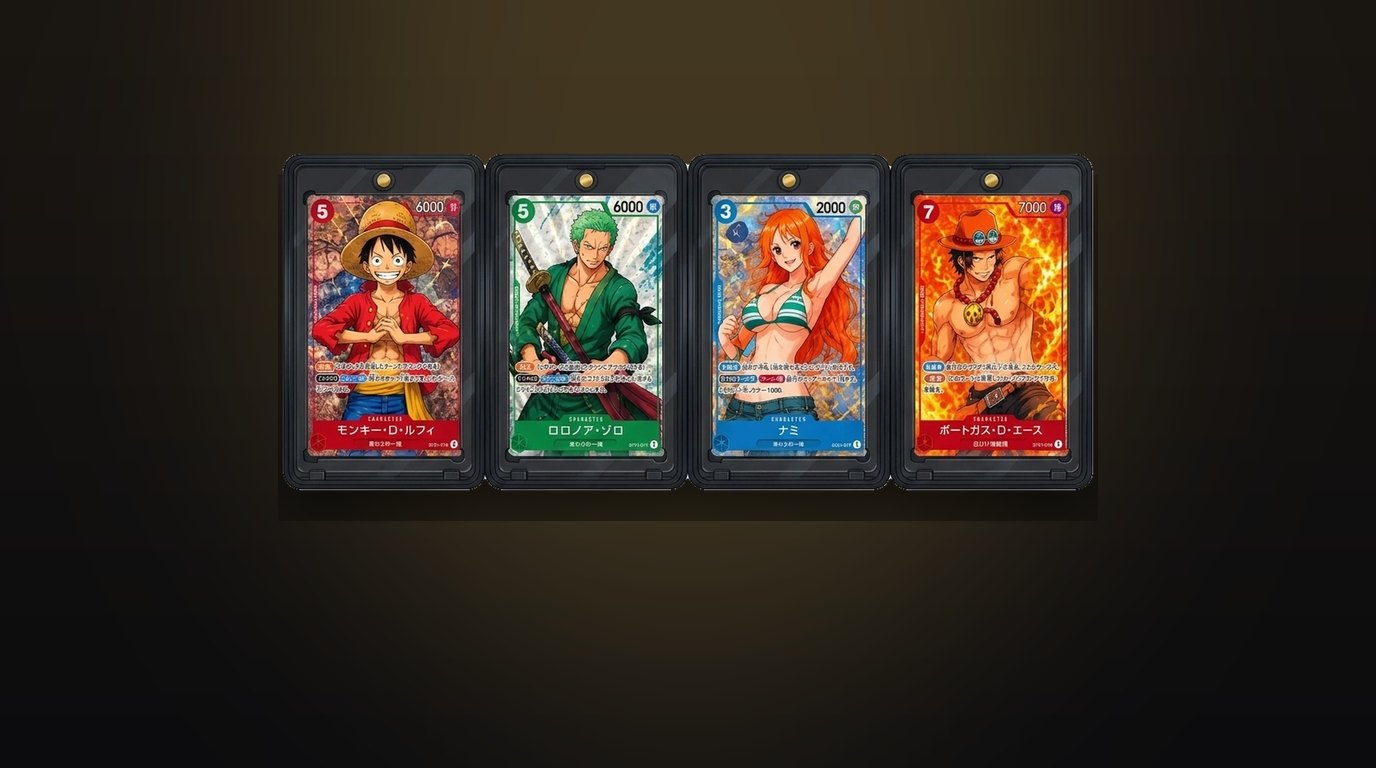
Which OP14 rarities should you target?
A Japanese OP set follows a well-known rarity ladder: C and UC for commons, then R, SR, SEC (Secret Rare) and L for leaders. Above them sit the parallel or alternate versions with different artwork, and the SPs, rarer still. The cards that define a set, the ones people hunt and display, are almost always at the top of that pyramid.
The right choice depends on your goal. For a first display piece, a parallel leader or parallel SR often gives the best balance between visual impact and budget. For a centrepiece, the set's SEC or an SP is the benchmark. Manga rares, when the set has them, are prestige pieces: highly sought after and rarely affordable. Commons only matter for completing a set or for playing.
Keep one simple rule in mind: at equal rarity, the character and the artwork drive demand. A parallel of a very popular character is chased harder than the SEC of a minor one. Look at the rarity to know what is rare, and at the character to know what will be wanted.
| Rarity | What it is | Who it suits | How to buy it |
|---|---|---|---|
| C, UC | Common cards | Players, full set | In boosters or bulk lots |
| R, SR | Rares and super rares | Players, first collection | As singles or in boosters |
| Parallel L | Leader with alternate artwork | Display, leader collection | As a single |
| Parallel SR | Super rare with alternate artwork | First display piece | As a single |
| SEC | The set's Secret Rare | Centrepiece | As a single |
| SP, manga rare | Rarest special versions | High-end collection | As a single, condition checked |

How do you check that an OP14 parallel or SP is the right version?
This is where most mistakes happen. A parallel differs from its base version through its artwork, often extended or entirely different, and its finish. Yet both share the same code and number: only a close look at the card, or a precise listing, tells you which one you are buying.
Be even more careful with SPs. An SP inserted into a set often reprints a card that has already been released and may keep its original code. The SP rarity mark, not the code alone, tells you what you are holding. The same logic applies to manga rares, recognisable by their background made of manga panels.
Before confirming a purchase, run through this short check:
- The printed code matches the listed card, with the rarity shown next to it (SR, SEC, L, SP).
- The artwork matches the version you want: base or parallel.
- The language is Japanese, if that is what you are after.
- The stated condition (A, A-, B, C) is consistent with the photos.
- The price is compared with other copies of the same version, not the base version.

Leaders and characters: which OP14 cards matter for a collection?
In every OP set, leaders hold a special place. They define the decks of the competitive format, their parallel version is often among the best-looking cards in the set, and many collectors choose to gather one leader per set. For OP14 this is an excellent entry point: an easily identified card, consistent with an ongoing collection, and usually more affordable than a SEC.
For characters, the popularity rule applies in full. The major figures of the story and the characters a set puts in the spotlight concentrate demand, in Japanese as in English. If your collection follows one character, OP14 interests you first for its versions of that character: compare them with each other before looking at the rest of the set.
One last nuance: tournament popularity pushes some cards up at release, and that effect can fade as the format evolves. For a lasting collection, artwork and character weigh more than in-game power. Buy what you will still enjoy displaying in several years.
Singles, boosters or a display: how should you buy OP14?
A Japanese display contains 24 boosters of 6 cards. High rarities, parallels, SECs and SPs, are not guaranteed, and one specific card may well not come out of an entire display. Opening boosters is fun, but it remains a lottery: if you want one particular card, the maths almost always favours buying the single.
A display still makes sense in two cases: you enjoy opening for its own sake, or you want to build a solid base of the set at the same time. For sealed products, OPCG.Shop offers Japanese displays, boosters and pre-orders, with shipping at €6.90, free from €199. Check OP14 availability at the time you buy.
For a specific card, singles remain the most direct route. Our Japanese cards are bought in Japan to order, with a stated condition and shipping at €4.20, free from €30 and paid only once per order. Grouping two or three OP14 cards in a single order is therefore often cheaper than ordering them separately.
Which condition should you choose and how do you judge an OP14 card's price?
Japanese cards are sold with a condition stated by the Japanese shop. For a display card, A or A- is the safer target. Condition B makes sense for a playing card or when the price gap is significant. Here is how to read these grades:
On price, keep the usual cycle of a set in mind: prices move a lot in the weeks after the Japanese release, while supply is still limited and attention is at its peak, then they often tend to settle. This is not an absolute rule: a reprint, a card that dominates tournaments or the arrival of the English version can shift demand.
The most reliable method remains comparison: same code, same rarity, same version, same condition. A price clearly below comparable copies often hides a difference in version or condition. We do not forecast prices: we give you the criteria to judge for yourself.
- A: near mint, the choice for a display piece or future grading.
- A-: very good, small barely visible flaws, often the best compromise.
- B: good, visible wear, worthwhile for play or to reach an expensive card.
- C: fair, best kept for play or as a filler card.
How should you display and store your OP14 cards?
A standout card deserves better than a binder. As soon as it arrives, slip it into a sleeve, then into a toploader or a one-touch frame. The aim is twofold: protect the corners and surface, which make up most of the condition, and be able to look at it without handling it.
Our aluminium one-touch magnetic frame, with double glazing, comes in black or white at €24.80 each, and the buy 2, get the 3rd free offer makes it easy to frame several cards from the same set. The frames snap together face to back to stack, stand upright like books, or attach side by side on a wall with an adhesive magnetic strip, no drilling needed.
For a set like OP14, a simple idea works very well: bring together the parallel leader, one or two parallel SRs and, if your budget allows, the SEC, then line them up on a shelf or wall. You get a coherent showcase of the set that keeps your cards safe from dust and handling.
For OP14 the verdict is simple: identify the card by its code and rarity, target the parallel leader, parallel SRs, the SEC or SPs depending on your budget, choose condition A or A-, and buy singles whenever you want one specific card. A display is a pleasure to open, not a strategy for landing a given card. Your next concrete step: browse our Japanese OP14 cards, compare the available versions, and plan a frame for the piece you will display.
Frequently asked questions
Is Japanese OP14 different from the English version?
The cards generally share the same content and codes, but the Japanese version comes out first and differs in language. For display, many collectors prefer Japanese. To play in tournaments in Europe, check which language the organiser accepts.
How can I tell whether a card really comes from OP14?
Look at the code printed at the bottom of the card: it starts with OP14 followed by a number. Watch out for SPs, which can reprint a card from an earlier set with its original code. In that case, the SP mark is what counts.
Should I wait before buying an OP14 card?
Prices often move sharply right after the Japanese release, then tend to settle, with no guarantee. If you like the card and its price is consistent with comparable copies, waiting is not necessary. For an expensive piece, comparing prices over a few weeks is sensible.
Is an OP14 card in condition B worth it?
For play, or to reach an expensive card on a tight budget, yes, as long as the price gap with condition A is real. For a display piece or future grading, prefer A or A-, because the visible wear of a B card shows behind glass.
Read next

Sets and releases
One Piece Card Game Japan release schedule: how to read it and plan ahead
One Piece Card Game Japan release schedule: how to read it, how far ahead of Europe Japan runs, when to preorder and what reprints change.
November 13, 2026

Sets and releases
EB01 Memorial Collection: the cards that matter and how to buy them
EB01 Memorial Collection: what makes this set different, which rarities to target and why buying singles is usually the smartest move.
November 13, 2026

Sets and releases
EB02 One Piece: the most wanted cards and how to buy them right
EB02 One Piece: which Japanese cards to target (SEC, parallels, SP), how to identify them, and why buying singles is usually the safest route.
November 13, 2026