
One Piece EB extension: how Extra Boosters differ from OP sets
Published on November 13, 2026 · 7 min read
Key points
- A One Piece Card Game EB (Extra Booster) set is a booster released outside the main OP series, usually more thematic and with a shorter card list.
- EB cards are identified by their code, which starts with EB followed by the set number (EB01 to EB05 in our Japanese catalogue).
- For one specific EB card, buying the single is more rational than buying a display, because booster contents are random.
- Like every set in the game, EB sets release in Japan first: only official announcements are reliable for dates and card lists.
You keep seeing codes like EB01, EB02 or EB04 on Japanese cards and wonder whether these sets really matter, or whether they are minor products squeezed between two big OP releases. It is a fair question: the One Piece Card Game has many formats (OP, EB, PRB, ST starter decks), and without a clear map you either buy at random or miss cards that deserve a place in your collection.
The short answer: an EB set, short for Extra Booster, is a booster outside the main series, usually more focused and more thematic than an OP, released between two major sets. It is neither a budget version nor a players-only product. In this article we settle what sets it apart from an OP, why collectors follow it closely and how to buy it in Japanese at the right time, as singles or as a display.
What is an EB set in the One Piece Card Game?
EB stands for Extra Booster. In the One Piece Card Game naming system, this prefix marks boosters published outside the main OP series, which runs from OP01 to OP18 in our Japanese catalogue. We currently list five EB sets, from EB01 to EB05, so the format is not a one-off experiment but a regular line of the game.
In practice, every card from an EB set carries a code that starts with EB, followed by the set number and then the card number. It is the only truly reliable way to know where a card comes from, far more than the artwork, since some characters and visuals appear across several products.
It also helps to place EB sets among the other formats. OP sets are the big releases that shape the game, ST products are preconstructed decks for beginners, and PRB sets are premium boosters built around special finishes and versions. EB sets sit in between: real boosters to open, but designed around a theme or a tighter selection.
| Format | Role in the game | Typical content | Collector appeal |
|---|---|---|---|
| OP (main booster) | Main series, regular rhythm | Broad selection of new cards | High, especially parallels and SEC |
| EB (Extra Booster) | In-between release, thematic | Tighter selection, often built on a theme | High, depending on theme and special versions |
| PRB (Premium Booster) | Premium product outside the series | Special versions and refined finishes | High, display-oriented |
| ST (Starter Deck) | Preconstructed deck to play | Fixed deck, no random pulls | Low to medium, mostly for leaders |

What are the real differences between an EB and an OP?
The first difference is purpose. An OP brings a block of new cards that moves the game forward, with many cards and often several colours in the spotlight. An EB is usually more focused: it rounds out what already exists, celebrates a theme or revisits characters with a specific art treatment. You buy it less to keep up with the game than for the story it tells.
The second difference is the size of the card list. An EB set usually has fewer cards than an OP, which changes how you collect: completing the set becomes more achievable, and each strong card carries more weight in the overall appeal of the set. A shorter list also means fewer filler cards.
Finally, the calendar differs. OP sets follow a regular cadence, while EB sets arrive between two main releases, like a breather. Rarity tiers stay the same as in the rest of the game (C, UC, R, SR, SEC, L, plus parallel versions), but their exact distribution depends on each set and should be checked product by product.
- Purpose: the OP moves the game forward, the EB completes or celebrates a theme.
- Card list: usually shorter on an EB, so easier to complete.
- Calendar: EB sets slot in between two OP sets.
- Rarities: same tiers as OP sets, distribution specific to each set.
- Code: EB prefix instead of OP, the only reliable marker.

Why should collectors follow EB sets?
Because they are often built to be loved. A strong theme, reworked artwork, popular characters in the spotlight: everything that makes a card end up framed on a shelf rather than filed away in a binder. For a display collection, EB sets are a natural source of standout pieces.
Because they move faster. An in-between set gets a shorter window of attention than a big OP: it releases, sells, then the next main set takes the spotlight back. For an attentive buyer, this creates moments when an EB card is available in Japan without release-day pressure, and others when it becomes hard to find.
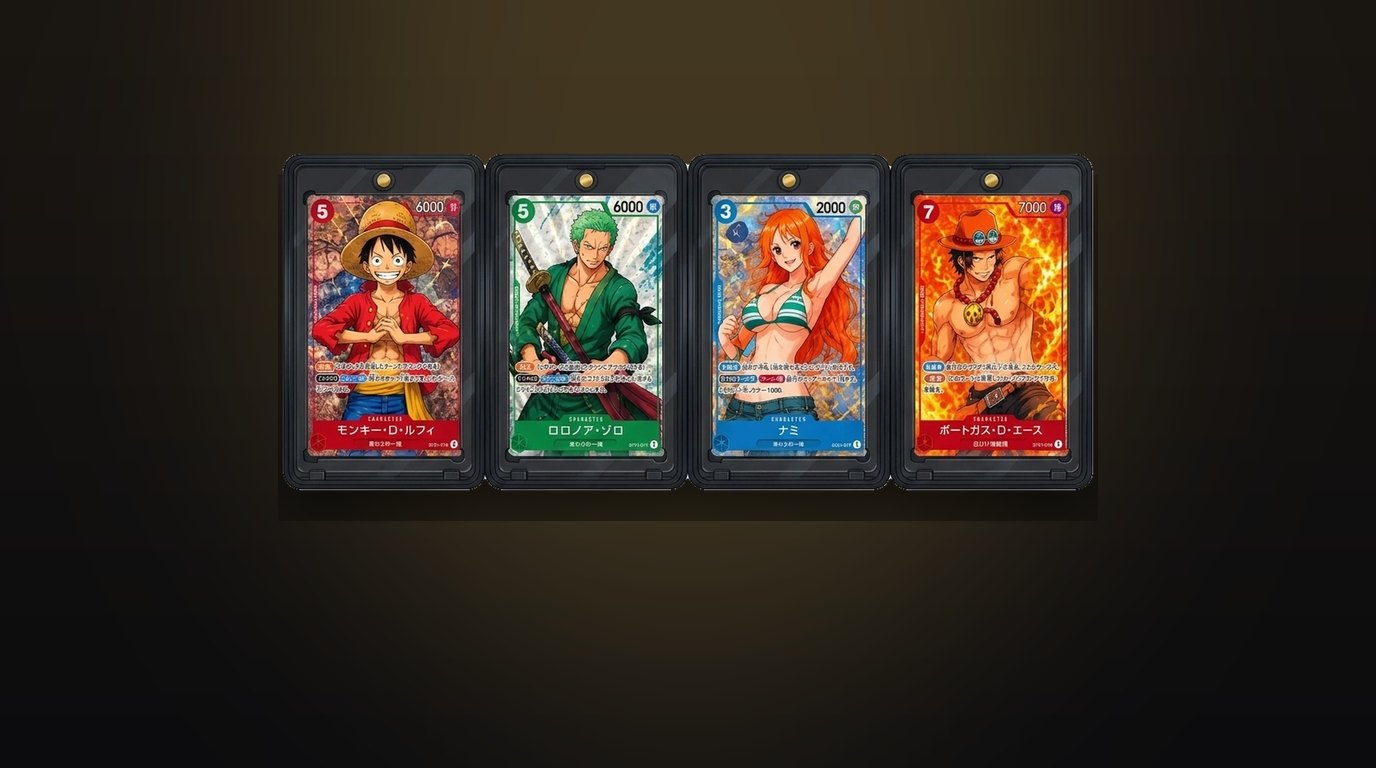
Because they complete a character collection. If you follow Luffy, Zoro, Nami or Ace across several sets, EB releases often bring versions that differ from the OP ones. Ignoring the format means leaving gaps in a themed collection and finding out too late that a missing version has become harder to get.
EB display or single cards: what should you buy?
It depends on your goal. If you enjoy opening, discovering and completing a set, a display makes sense: a Japanese display usually holds 24 boosters of 6 cards, and a shorter EB list makes completion more realistic than with a big OP. Always check the product page, though, as the exact format can vary from set to set.
If you are after one specific card, a character parallel or a SEC, buying the single is almost always more rational. Pulls are random, and opening several displays for one card rarely costs less than buying it outright. That is exactly what our Japanese singles are for: every card listed is genuinely on sale in Japan and bought when you order.
A sensible middle ground for many collectors: one display for the joy of opening and the core of the set, then singles for the two or three missing cards. On costs, shipping for a card order is €4.20, free from €30, and for sealed products €6.90, free from €199. Shipping is charged only once per order.
How do you recognise an EB card and check what you are buying?
The code printed on the card is your first check. An EB card carries a code such as EB01 followed by a number, which tells you the source set without ambiguity. This is essential when the same character exists in an OP, an EB and a promo with similar artwork.
The second check is rarity and version. A parallel, or alternate art card, differs from the standard version through its artwork and finish, and the rarity is printed on the card. On any listing, ask for a sharp photo of the front with a readable code, and be wary of descriptions that stay vague about the version.
The third check is condition. Japanese shops use standard grades: A (near mint), A- (very good), B (good, visible wear), C (fair). For a card you plan to display, aim for A or A-. To complete a set on a budget, a B can be perfectly fine.
- Read the code: EB prefix, set number, card number.
- Check the stated rarity and the version (standard or parallel).
- Check the stated condition: A, A-, B or C.
- Compare with the same card in an OP or promo version if one exists.
- Plan protection: a sleeve first, then a frame if the card is displayed.

How do you follow upcoming EB sets without getting caught out?
Sets release in Japan first, and EB sets are no exception. Official Japanese announcements come before any Western version: that is the source to watch. Everything else, blurry images, unconfirmed card lists, dates presented as likely, remains rumour until the publisher has released it.
Next, do not confuse announcement with availability. Between the official reveal of an EB and the moment its cards actually circulate, there are usually several weeks. The first days after release are often the most volatile for single prices: if a card is not urgent for you, letting the hype settle is a simple and effective method.
Finally, if you want sealed product, pre-ordering from a reliable seller remains the calmest way to secure a display. On OPCG.Shop, pre-orders are paid in full and refunded in full if the product does not reach us: the risk is on timing, not on your money.
EB or OP18: where should your budget go this season?
The two do not compete, they complement each other. A big OP like OP18 remains the core product, the one that brings the most new cards and feeds the game for months. An EB is a more targeted purchase, made for a theme, a character or one card in particular.
If your budget only allows one sealed product, pick the one whose card list speaks to you most and complete the other with singles. The Japanese OP18 display is currently on pre-order at €129 in our shop. For an EB that is already out, singles are often the most direct path to what you really want.
Think about what comes after the purchase, too. A beautiful EB card deserves to be seen: our magnetic one-touch frame, at €24.80 each (buy 2, get the 3rd free), protects the card behind double glazing, stands upright like a book or mounts on the wall without drilling thanks to the adhesive magnetic strip.
Pre-order
OP18 booster display (Japanese)
129,00 €
View the productThe verdict: an EB set is neither a by-product nor a mere bonus. It is a more focused booster, often thematic, with a shorter list where the best cards clearly stand out, ideal for a character collection or a display collection. Your next concrete step: identify the EB codes that interest you, buy the specific cards you want as singles, and keep sealed purchases, such as the OP18 display on pre-order at OPCG.Shop, for the products you genuinely want to open.
Frequently asked questions
What does EB mean in the One Piece Card Game?
EB stands for Extra Booster. It is a set outside the main OP series, usually more thematic and with a shorter card list. Its cards carry a code starting with EB.
Are EB cards playable like OP cards?
Yes, they are cards from the same game and can be used in decks under the current rules. The difference lies in the origin and content of the set, not in their status. Check the official format rules before a tournament, though.
Is it better to buy an EB display or single cards?
A display suits you if you enjoy opening packs and completing the set. For one specific card, singles are almost always more rational, because pulls are random. Many collectors combine both: a display for the core of the set, singles for what is missing.
Do EB sets release in Japan first?
Yes, like the other One Piece Card Game sets, they are published in Japan first. Official Japanese announcements are therefore the source to follow. Anything not found there is still a rumour.
Read next

Sets and releases
One Piece Card Game Japan release schedule: how to read it and plan ahead
One Piece Card Game Japan release schedule: how to read it, how far ahead of Europe Japan runs, when to preorder and what reprints change.
November 13, 2026

Sets and releases
EB01 Memorial Collection: the cards that matter and how to buy them
EB01 Memorial Collection: what makes this set different, which rarities to target and why buying singles is usually the smartest move.
November 13, 2026

Sets and releases
EB02 One Piece: the most wanted cards and how to buy them right
EB02 One Piece: which Japanese cards to target (SEC, parallels, SP), how to identify them, and why buying singles is usually the safest route.
November 13, 2026