
One Piece promo cards: which Japanese promos (P) to collect
Published on November 13, 2026 · 8 min read

Key points
- A One Piece promo card has a code starting with P (for example P-001) and the rarity P: it belongs to no expansion and cannot be pulled from regular booster packs.
- In Japan, promo cards mainly circulate through official tournaments and events, magazines, purchase bonuses with products and time-limited campaigns.
- The promos most worth collecting combine three things: a popular character, exclusive artwork and a genuinely limited distribution.
- Japanese promos are bought as single cards. Before buying, check the P code, the stated condition (A, A-, B or C) and that the artwork matches the official images.
You have spotted a card with a small P in its code and artwork you have never seen in a booster pack. Now you are wondering where it comes from, whether it is worth anything and how to get it from Europe. That is the typical situation with a One Piece promo card: often stunning, sometimes highly sought after, yet distributed in ways that are hard to follow if you do not live in Japan.
The short answer: a promo card sits outside the expansions. It is handed out at events, in magazines or with products, and you will almost never pull one from a booster. To collect promos, you buy them as singles and target the ones that combine a strong character, exclusive artwork and a limited distribution. Here is how they circulate, which ones to aim for and how to buy them without mistakes.
What exactly is a One Piece promo card?
In the One Piece Card Game, promo cards form their own category. Their code starts with P followed by a number (P-001, P-002 and so on), and their rarity is simply marked P. They do not belong to any numbered expansion such as OP01 or EB01: they are not on any booster's card list, and opening a display will never give you one.
Their content varies a lot. Some promos are brand new cards with their own effect. Others reuse a known character or effect with new artwork, a different frame or a special marking. There are also promotional DON!! cards, whose alternate artwork is popular with collectors who care about the look of their deck or display.
For a collector, promos are interesting in two ways: they are often harder to find than a common expansion card, and their artwork is frequently exclusive. They are also the hardest category to keep track of, because distribution methods change from one campaign to the next and are rarely documented outside Japan. That is why you need a clear method before you buy.

How do promo cards circulate in Japan?
In Japan, promos are distributed through a few main channels. The first is official tournaments and events run by stores or by the publisher: participation cards, cards for the top-ranked players and sometimes special versions for winners. These promos are tied to a specific period, which naturally limits how many copies end up in circulation.
The second channel is Japanese magazines and publications, which regularly include a promo card in a given issue. The third is purchase bonuses: a promo given away with a product, a box set, a pre-order or during an in-store campaign. Finally, some special products, such as box sets or premium collections, include promo cards directly.
The direct consequence: once distribution ends, the promo is only available on the Japanese secondary market, through specialised Japanese shops and platforms. That is where prices are set, based on demand and on how many copies were actually handed out. From Europe, buying singles through an intermediary who buys in Japan remains the simplest and safest route.
- Official tournaments and events: participation, ranking or winner cards.
- Japanese magazines and publications: a card inserted in a specific issue.
- Purchase bonuses: a promo given with a product, a box set or a pre-order.
- Special products: box sets and collections that contain promos.
- Limited campaigns: one-off in-store operations or release events.
Japanese or English promo: which should you choose?
Promos exist in both languages, but they do not always match. Expansions come out in Japan first, and the Japanese event calendar is specific to that market: some promos have no English equivalent, others arrive later or with different artwork. Comparing both versions card by card is essential before you buy.
For collecting, the Japanese promo has several strengths: generally excellent print quality, Japanese text that adds to the authenticity of the piece and often a wider variety of artwork. For playing, the English version is more practical at European tournaments. But in a display case or a frame, language matters far less than the artwork.
Our view: if your goal is to display cards or build a collection around a character, go for the Japanese promo. If you play at local tournaments and want a card everyone can read, the English version makes sense. Either way, make sure you are buying the promo you want, not an expansion version with similar artwork.
| Criterion | Japanese promo | English promo |
|---|---|---|
| Availability | Distributed first, in Japan | Depends on each region's events |
| Variety of promos | Often wider | Depends on campaigns |
| Readability in play | Japanese text, effect to learn | Text readable at once |
| Appeal for display | Strong: artwork and authenticity | Good |
| Getting it from Europe | Singles through an intermediary | Local events or secondary market |
Which One Piece promo cards should you collect first?
Not all promos are equal. Start with the character: Luffy, Zoro, Nami, Ace, Shanks and the Yonko attract most of the demand, and a promo featuring them stays sought after long after its distribution ends. A secondary character can be gorgeous, but demand will be narrower, which is actually good news if you collect for pleasure.
The second criterion is the artwork. A promo with truly exclusive art, absent from the expansions, has more collecting value than a simple reprint with a marking. The third is the distribution method: a promo reserved for winners or a short event is structurally rarer than one slipped into a product sold in large quantities.
Finally, think about consistency. A collection of promos built around a crew, an arc or a character tells a story and looks great in a row of frames. Rather than buying every promo that comes along, set yourself a theme and a budget, then complete your series patiently as cards appear on the Japanese market.
- High-demand character: Luffy, Zoro, Ace, Shanks, the Yonko.
- Exclusive artwork, absent from expansion boosters.
- Limited distribution: winners, short event, one-off campaign.
- Verifiable condition, ideally A or A-.
- A fit with your collection: crew, arc or character.

How can you recognise a genuine Japanese promo card?
Start with the code printed on the card: it must start with P and match the card being advertised. Then check the rarity, the language of the text, whether the artwork matches the official images and the print quality. A genuine Japanese promo shows crisp colours, sharp text and a back identical to every other card in the game.
Be wary of vague listings that say 'promo' without a visible code, or that present an alternate art expansion card as a promo. The two categories are easily confused: an expansion parallel carries its expansion code, while a promo carries a P code. This simple check prevents a lot of disappointment and overpriced purchases.
Condition matters as much as authenticity. Tournament promos have often passed through players' hands, and magazine promos can show packaging marks. With us, the condition is the one stated by the Japanese shop: A (near mint), A- (very good), B (good, visible wear) or C (fair). For a display, aim for A or A-.
- Code starting with P, matching the advertised card.
- Rarity P shown on the card.
- Artwork identical to the official images.
- Crisp printing, correct colours and back.
- Condition clearly stated: A, A-, B or C.

What should you pay for a promo card, and when should you buy?
There is no standard price for a promo. A card widely distributed with a popular product can stay very affordable, while a tournament winner promo or one from a short event can reach high levels. The price depends on the character, the number of copies distributed, the condition and how much players value the card's effect.
Timing matters too. Right after a distribution ends, many copies reach the Japanese market and prices often tend to settle. Later, once collectors have absorbed the supply, the promo becomes harder to find in good condition. If you really love a card, the period just after its distribution is often the most favourable moment to buy.
To compare, look at the price shown for each card and add the fees. On our site, prices are in euros including VAT, and card shipping costs €4.20, free from €30; shipping is only paid once per order. Grouping several promos into one order is therefore the easiest way to lower your real cost.
How should you protect and display your promo cards?
A promo is often the most distinctive piece in a collection, because its artwork exists nowhere else. It deserves immediate protection: a sleeve as soon as it arrives, then a rigid holder. Avoid leaving it in a binder that is too tight or in direct sunlight, which fades colours over time.
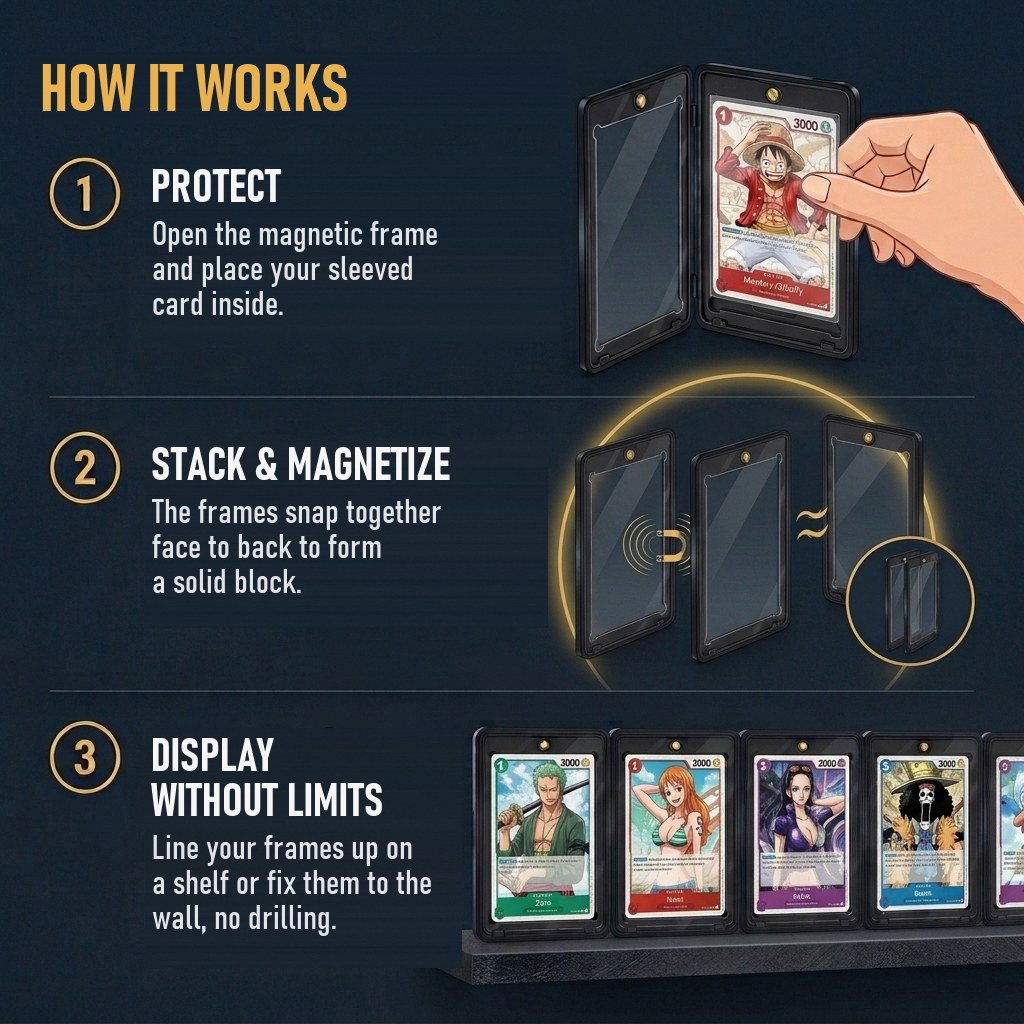
Our aluminium one-touch magnetic frame, with double glass, in black or white, is designed for exactly this: the sleeved card stays flat, protected from dust and on show. The frames snap together face to back to stack, stand upright like books and attach side by side to the wall with an adhesive magnetic strip, with no drilling.
For a series of promos, a row display works very well: a few frames side by side on a shelf or on the wall, sorted by character or period. The frame costs €24.80 each, and when you buy two, the third is free. That is enough to start a small promo gallery on a controlled budget.
Verdict: a Japanese One Piece promo card is one of the best ways to personalise a collection, as long as you choose it for its character, its exclusive artwork and how limited its distribution really was, not just because it says 'promo'. Since it does not come out of boosters, buying singles is the logical route. Your next concrete step: pick a character or a crew, browse our Japanese cards while checking the P code and the stated condition, group your favourites into one order, then give them a frame worthy of them.
Frequently asked questions
Can you pull a One Piece promo card from a booster pack?
As a rule, no: promo cards, with their P code, are distributed outside expansion boosters, at events, in magazines or with products. A rare card pulled from a booster carries its expansion code. To get a specific promo, buying it as a single is the way to go.
Is a One Piece promo card always valuable?
No. A promo widely distributed with a popular product can stay very affordable. Its value depends mainly on the character, how exclusive the artwork is, how many copies were distributed and the card's condition.
How can I tell a promo from an alternate art card?
Look at the printed code: a promo starts with P, while an expansion card starts with OP, EB, ST or PRB, even when its artwork is alternate. The rarity printed on the card confirms the category.
Can I play Japanese promos at tournaments in Europe?
The Japanese and English versions of the game are managed separately, and a European tournament will not necessarily accept Japanese cards. Check with the organiser before you play. For collecting or displaying, however, a Japanese promo is an excellent choice.
Read next

Buying guides
Buy One Piece cards as singles: the math that beats opening boosters
Buying a single One Piece card usually costs less than opening boosters to chase it. Here is the calculation, the exceptions and a clear method.
November 13, 2026

Buying guides
Buying Japanese One Piece cards from Europe: the complete guide
Where to buy Japanese One Piece cards in Europe, what they really cost once delivered and how long they take: a clear method to buy without bad surprises.
November 13, 2026

Buying guides
Japanese or English One Piece booster: differences and which to choose
Japanese or English One Piece booster? Real differences in content, price, rarity and resale, and which version to pick for your goal.
November 13, 2026