
Buy One Piece cards as singles: the math that beats opening boosters
Buying a single One Piece card usually costs less than opening boosters to chase it. Here is the calculation, the exceptions and a clear method.
Published on November 13, 20267 min read

Key points
- To get one specific One Piece card, buying the single is almost always more rational than opening boosters, because it replaces an uncertain draw with a fixed, known price.
- A Japanese display contains 24 boosters of 6 cards, but no specific card is guaranteed: the real cost of a target card chased in boosters is the sum of every booster opened until it appears.
- Before buying a One Piece single, check its code, rarity, version (parallel or not) and stated condition: A, A-, B or C.
- Boosters and displays remain worthwhile for the joy of opening, for playing or for sealed collecting; the healthiest strategy combines budgeted opening with completing your list as singles.
You are after one specific card, a parallel Leader, an SR of your favourite character, and you hesitate: open boosters hoping to pull it, or buy it directly as a single? Almost every collector of the Japanese One Piece Card Game faces this question sooner or later, often after one or two displays opened without ever seeing the card they wanted.
The answer is clear: if your goal is a specific card, buying the single is almost always the rational choice, because it replaces a probability with a certainty. This guide gives you the calculation to check it yourself, the cases where opening still makes sense, the criteria for choosing a single well and the method to pay the right price, shipping included.
In this article
- 1. Why buy a One Piece card as a single rather than open boosters?
- 2. How much does a target card really cost if you open boosters?
- 3. When is opening boosters still a good choice?
- 4. How do you choose the right One Piece single?
- 5. How much does an order of singles cost, shipping included?
- 6. How do you protect and display a card bought as a single?
- 7. Which method should you follow for your first single purchase?
Why buy a One Piece card as a single rather than open boosters?
Opening a booster means buying a draw. You pay for six cards whose identity, rarity and character you do not choose. Buying a single is the opposite: you pay for an identified card, in a precise version, with a stated condition. Both approaches are legitimate, but they do not meet the same need, and confusing them gets expensive.
The problem appears when you open boosters to get one particular card. Every booster that does not contain it is money that brings you no closer to your goal, and recent Japanese sets include many rare, parallel and alternate art cards competing for the most coveted slots. The richer the set, the more your target card gets diluted.
With singles, the reasoning becomes simple: you see the card, its price and its condition, and you decide. No bad surprises, no duplicates to resell, no pile of commons forgotten in a drawer. For a showcase or a collection built around one character, it is the most direct way to create something coherent.
How much does a target card really cost if you open boosters?
The calculation that changes everything fits in one idea: when you open for a specific card, its real price is not the price of one booster but the sum of every booster opened until it shows up. If it never does, you have paid for nothing as far as your goal is concerned. With a single, the displayed price is the final price.
To settle your own case, put the numbers on paper instead of trusting your gut. The method below works for any set, and it avoids the classic trap of telling yourself that a display is cheaper per card when most of those cards do not interest you at all.
In most cases the comparison clearly favours singles as soon as the target is a high rarity. A display only becomes competitive if you genuinely value the rest of the contents: the fun of opening, playing, completing a list of cards or keeping the product sealed.
- Write down the single price of your target card, shipping included (€4.20, free from €100 with us).
- Write down the price of the display or boosters, shipping included (€6.90, free from €199 for sealed products).
- List honestly the cards from the display you would really keep, apart from the target.
- Remember that the target card is not guaranteed: account for the scenario where it does not appear.
- Compare: certainty at a fixed price on one side, a draw at the display price on the other.
| Criterion | Single card | Loose boosters | Sealed display |
|---|---|---|---|
| Specific card guaranteed | Yes | No | No |
| Budget known in advance | Yes | Depends on your discipline | Yes, but for a draw |
| Opening experience | No | Yes | Yes, at its fullest |
| Choice of condition | Yes (A, A-, B, C stated) | No, new but random centring | No, new but random centring |
| Duplicates and unwanted cards | None | Frequent | Many |
| Best for | Targeting a card, a showcase | Discovering a set | Opening, playing, keeping sealed |
When is opening boosters still a good choice?
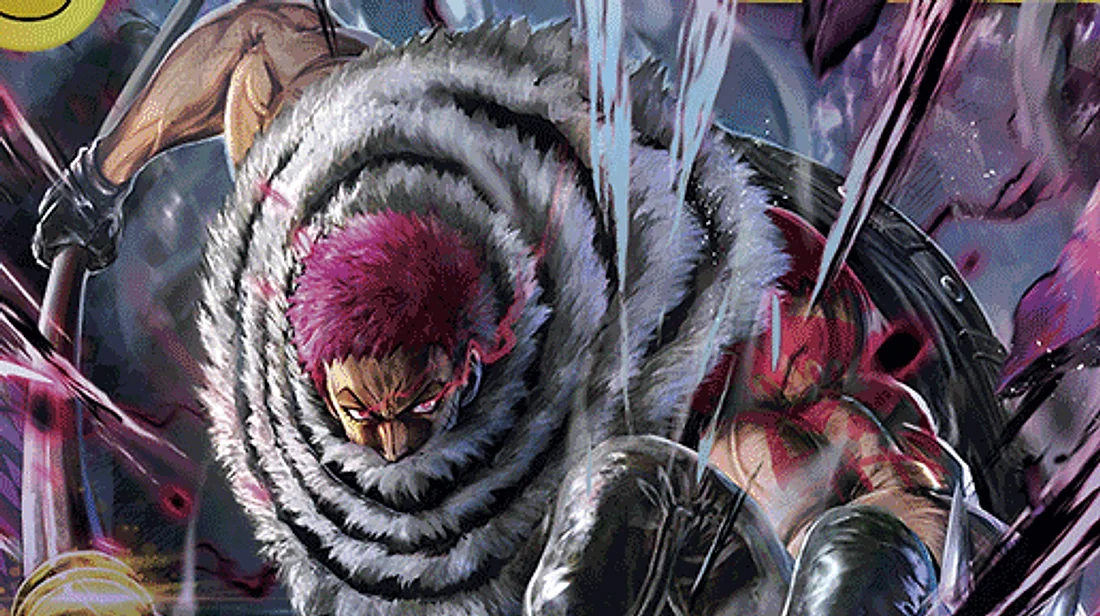
Choosing singles does not mean condemning boosters. Opening a Japanese display remains a real pleasure, and for many players it is the heart of the hobby. If the moment of opening matters as much to you as the cards themselves, a display is not a bad deal: it is a different product, selling an experience rather than a card.
A display also makes sense if you play and need plenty of commons and uncommons from the same set, if you want to keep a sealed product, or if you enjoy discovering a set card by card. For those cases, OPCG.Shop offers Japanese displays, boosters and pre-orders, with pre-orders fully refunded if the product does not reach us.
The healthiest strategy often combines both: open for fun with a budget set in advance, then complete the missing cards as singles. You keep the thrill of opening without being dragged into an endless chase after a single card.
How do you choose the right One Piece single?

Buying singles only protects you from mistakes if you know exactly what to buy. The same character often exists in several versions: base card, parallel, alternate art, promo, Leader. The card code, for example OP05 or EB01 followed by a number, and its rarity are your most reliable markers to tell two similar versions apart.
Next comes condition. Our Japanese cards are bought in Japan to order, and the condition stated by the Japanese shop is shown: A for near mint, A- for very good, B for good with visible marks, C for fair. For a showcase, aim for A or A-. For a binder or a playing card, B can be an excellent compromise.
Finally, ask yourself why you want this card. A display piece deserves a striking rarity and fine condition; a deck card above all needs to be playable; a gift should speak to the person receiving it. This simple question prevents most regretted purchases.
- The exact code of the card and its set (OP, EB, ST, PRB, P).
- The rarity: C, UC, R, SR, SEC, L, SP or P, and whether it is parallel or alternate art.
- The stated condition: A, A-, B or C, depending on the intended use.
- The language: Japanese, for a consistent Japanese collection.
- The final use: showcase, binder, deck or gift.
How much does an order of singles cost, shipping included?
The price of a card is not the price of an order. With us, shipping for cards and frames costs €4.20 and becomes free from €100, and it is paid only once per order. Shipping therefore weighs heavily on one low-priced card on its own, and drops to zero as soon as you group your purchases.
Good practice is to prepare a list and order in one go. Two or three target cards in the same order, or a card together with its frame, pay shipping only once. A magnetic frame costs €24.80: with a second frame, €49.60 in all, or from €100 of purchases, shipping is free.
Then compare with sealed products: shipping for a display or boosters costs €6.90 and is only free from €199. For a buyer chasing a few cards, singles keep the order light, without committing a large sum to an uncertain draw.
How do you protect and display a card bought as a single?
A carefully chosen card deserves better than a drawer. The first step is a sleeve, a soft pouch that protects the surface from scratches and dust. For a showcase card, the next step is a rigid holder that keeps it flat and away from handling.
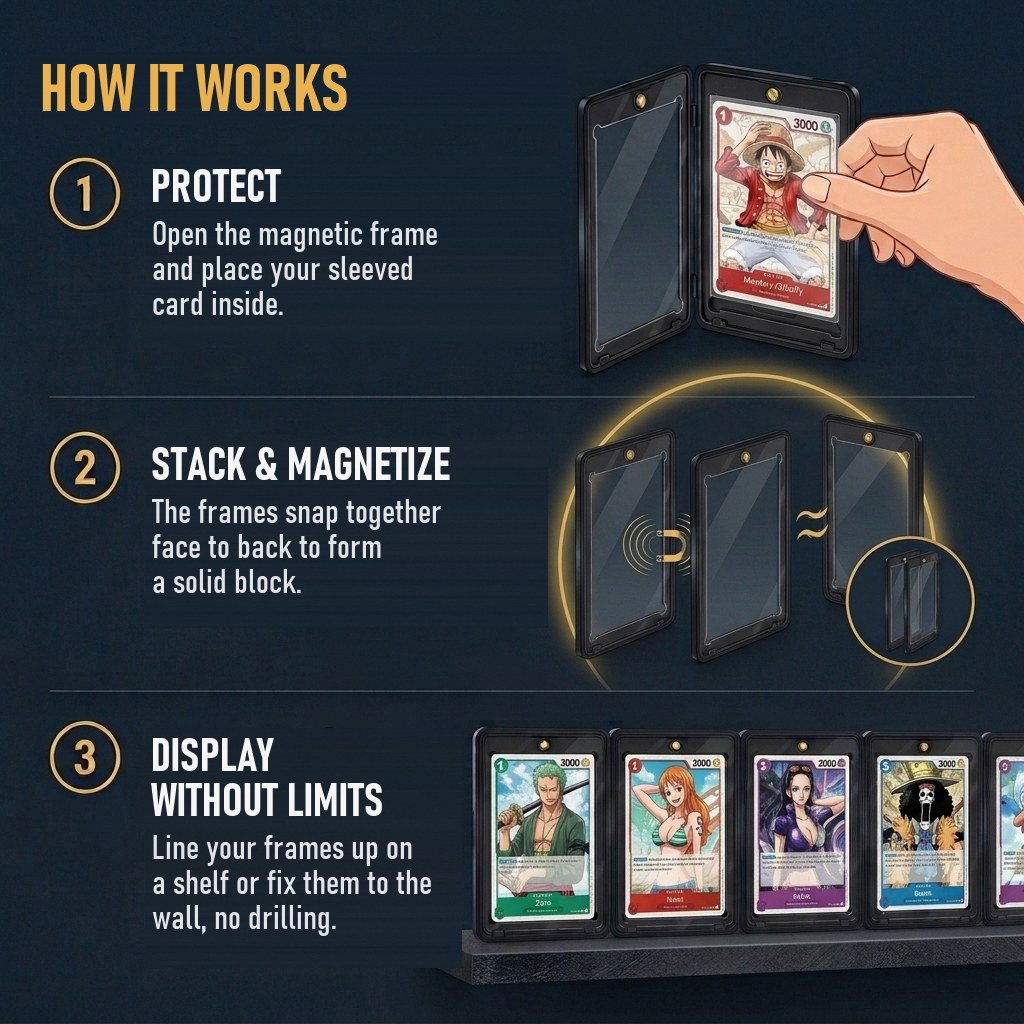
Our one-touch magnetic frame in aluminium, with double glass, in black or white, costs €24.80 each, and the third is free when you buy two. The frames snap together face to back to stack, stand upright like books and attach side by side on the wall with an adhesive magnetic strip, no drilling needed.
This is where buying singles takes on its full meaning: you build a showcase in which every card was chosen, instead of displaying whatever luck left you. For an already graded card, a PSA slab compatible version exists at €34.80, sold empty.
Which method should you follow for your first single purchase?
The most reliable method fits in a few steps, and it works for a first card as well as for the twentieth. Its principle: decide before looking at prices, then compare calmly instead of giving in to the first version you come across.
If you love surprises but want to avoid boosters, the Mystery Box is an alternative: a draw of real Japanese cards, bought in Japan and then shipped. It keeps the pleasure of discovery, without claiming to replace the targeted purchase of a specific card.
Finally, keep a record of your purchases: code, version, condition, price paid. This little log helps you avoid duplicates, measure what you have really spent and spot, over time, the cards still missing from your collection.
- Choose the character or theme of your collection.
- Identify the exact version: code, rarity, parallel or not.
- Set the minimum condition according to use: A or A- for a showcase.
- Group cards and frames: shipping is free from two frames or from €100.
- Protect the card as soon as it arrives, then display it.
Verdict: for a specific card, buy the single. You pay for certainty, you choose the version and condition, and you control the final cost, shipping included. Keep boosters and displays for what they do best, the joy of opening and sealed collecting, with a budget set in advance. Your next step: write down the card you are after, check its code and rarity, then browse our Japanese singles to find it in the condition your showcase deserves.
Frequently asked questions
Is it cheaper to buy a One Piece card as a single than to open boosters?
For a specific card, yes in the vast majority of cases, because you pay a fixed price instead of a series of draws with no guarantee. Boosters only become worthwhile if you also value the rest of the contents or the pleasure of opening.
What do conditions A, A-, B and C mean on a Japanese card?
They are the conditions stated by the Japanese shop: A for near mint, A- for very good, B for good with visible marks, C for fair. For a showcase, favour A or A-; for a binder or a deck, B is often enough.
How much does shipping cost for a One Piece single?
Shipping for cards and frames costs €4.20 and is free from €100. It is paid only once per order, which is why grouping several cards, or a card and its frame, in one basket makes sense.
Should I stop buying One Piece displays?
No. A display remains the right choice for the joy of opening, for playing or for keeping a sealed product. The only mistake is opening one to chase a specific card: in that case, a single is safer and clearer.
Read next
 Buying guides
Display OP16 or OP15: which one to catch up on at 129 €, plus 6 singles
November 25, 20267 min read
Display OP16 or OP15 at 129 €: the verdict by character, 6 named cards with their prices, and when buying singles is the smarter move.
 Buying guides
Which Japanese One Piece display to choose: OP18, OP17 or EB05 at 129 €?
November 25, 20267 min read
OP18, OP17 or EB05 at the same 129 €: a decision table, 5 reference cards with prices, and the maths on two displays with free shipping.
 Buying guides
One Piece Mystery Box: how it works, 6 steps from payment to frame
November 25, 20268 min read
Payment, age check, online reveal of your 3 cards, purchase in Japan, shipping: the Mystery Box at 29,90 € step by step, and what you don't choose.