
How to store a card collection: binder, box or frame, which is best?
Published on November 20, 2026 · 8 min read

Key points
- The safest way to store a large One Piece card collection is to sort it into three tiers: bulk cards in boxes, cards you browse in a pocket binder, and valuable cards in rigid protection or a frame.
- A standard ring binder damages the cards closest to the rings; a binder with stitched pages and side-loading, PVC-free pockets is the better choice.
- Every card should go into a sleeve before it enters a binder, a toploader or a frame: the sleeve is the first barrier against scratches, rubbing and dust.
- The real enemies of a stored collection are humidity, direct sunlight and pressure: storing cards upright, in a temperate room away from windows, prevents most damage.
You started with a few boosters, then the cards piled up: hundreds of commons, dozens of rares, and a handful of Japanese pieces worth far more than everything else. At some point the shoebox stops being enough and the question becomes serious: how do you store a card collection without damaging it, while still finding a specific card in a few seconds?
The answer comes down to one rule: not every card should be stored the same way. Bulk cards go in rigid boxes, cards you want to browse and complete go into a quality binder, and valuable cards deserve rigid protection, ideally a one-touch frame that works as both a safe and a display. Here is the full method, the storage options compared, and the mistakes that cost money.
How should you organise a large collection before storing it?
Good storage starts with sorting, not shopping. As long as your cards are mixed up, any storage solution will end up messy, and digging through piles is exactly how corners get bent and surfaces scratched. So begin by splitting the collection along one simple criterion: what each card means to you, in value and in attachment.
Three tiers are enough in almost every case. The first holds bulk cards: commons and uncommons in multiple copies, duplicates, DON!! cards. The second gathers the cards you want to browse and complete: a set you follow, a character you collect, your rares and super rares. The third brings together your valuable pieces: Secret Rares, parallel versions, alternate art leaders, SPs, sought-after promos, or simply the card that matters most to you.
This sort pays off immediately: it tells you how much space each type of storage needs, and it stops you spending on rigid protection for cards that do not need it. It also prevents a valuable card from being forgotten at the bottom of a box of duplicates, which happens far more often than collectors like to admit.
- Tier 1, bulk and duplicates: rigid storage box, sorted by set or colour.
- Tier 2, cards to browse: pocket binder, sleeved, by set or by character.
- Tier 3, valuable cards: sleeve, then toploader or one-touch frame, stored upright or on display.
Binder, box or frame: which storage protects best?
Each option meets a different need, and none of them does everything. A box is unbeatable for density: it holds a lot of cards in little space, as long as they stand upright and fit snugly. A binder is unbeatable for browsing: you turn the pages, see everything and spot the gaps. A one-touch frame is unbeatable for protecting a single card, because it locks it inside a rigid case that cannot bend.
Each one's weakness is just as clear. An overfilled box squeezes the cards, a half-empty one lets them slide and wear at the edges. A poorly chosen or overloaded binder curves the cards, and constant page turning wears out the pockets. A frame takes more space per card: it is meant for the pieces that deserve it, not for five hundred commons.
The table below sums up the criteria that really matter for a large collection. The point is not to crown a winner, but to match each tier of your sort with the storage that suits it.
| Storage | Protection against bends | Storage density | Browsing | Best for |
|---|---|---|---|---|
| Rigid storage box | Good if cards stand upright and the box is well filled | Very high | Slow, you have to dig | Bulk cards, duplicates |
| Standard ring binder | Poor near the rings | Medium | Fast | Avoid for valuable cards |
| Stitched-page binder, side-loading | Good | Medium | Fast | Cards to browse and complete |
| Toploader | Very good | Medium | Medium | Valuable cards in storage |
| Magnetic one-touch frame | Excellent, rigid case | Lower per card, but stackable | Instant, the card stays visible | Valuable cards to keep and display |
Which binder should you choose to avoid damaging your cards?
The binder is the most widely used storage option and the one that causes the most silent damage. The usual culprit is the office ring binder filled with hole-punched pages: cards in the column closest to the rings end up curved or dented, and the rings can pinch the pockets when the binder closes. For a collection you intend to keep, rule this format out.
A good binder has pages stitched or fixed into the spine, side-loading pockets that stop cards sliding out when you hold it upright, and a rigid cover that closes properly, often with a strap or a zip. Nine-pocket pages are the most common format; smaller pages reduce the weight of cards pressing on one another.
Slide each card into a sleeve before it goes into a pocket: the sleeve protects the surface when you take the card out and avoids direct rubbing against the plastic. Never put two cards in the same pocket, never fill the binder beyond its intended capacity, and store it upright on a shelf, never flat under a stack of books.
- Stitched or fixed pages, no metal rings.
- Side-loading pockets labelled acid-free and PVC-free.
- Rigid cover with a closure, strap or zip.
- One card per pocket, already sleeved.
- Stored upright, like a book.

How do you use storage boxes properly for bulk cards?
For hundreds of commons, uncommons and duplicates, the storage box is still the most sensible choice. It is cheap, fits anywhere and protects cards well on two conditions: the cards must stand upright, and the box must be full without being compressed. A half-empty box lets cards fall flat and rub, a crammed one bends their edges.
Go for rigid plastic or thick cardboard boxes designed for cards, with dividers. Dividers are what make a box genuinely usable: one per set or per colour, and you can find a card in seconds. If the box is not full, fill the gap with a divider or a foam block rather than letting the cards tip over.
Sleeves are not mandatory for bulk cards, but they become useful as soon as a card has some value or gets handled often for play. Label each box on its spine with its contents: it is a small detail, but it is what turns a pile of stock into an organised collection.
- Cards upright, never flat.
- Box filled without forcing, empty space taken up.
- Dividers by set or by colour.
- Label on the spine listing the contents.
- Boxes kept off the floor and away from outside walls.
Why keep valuable cards in a one-touch frame?
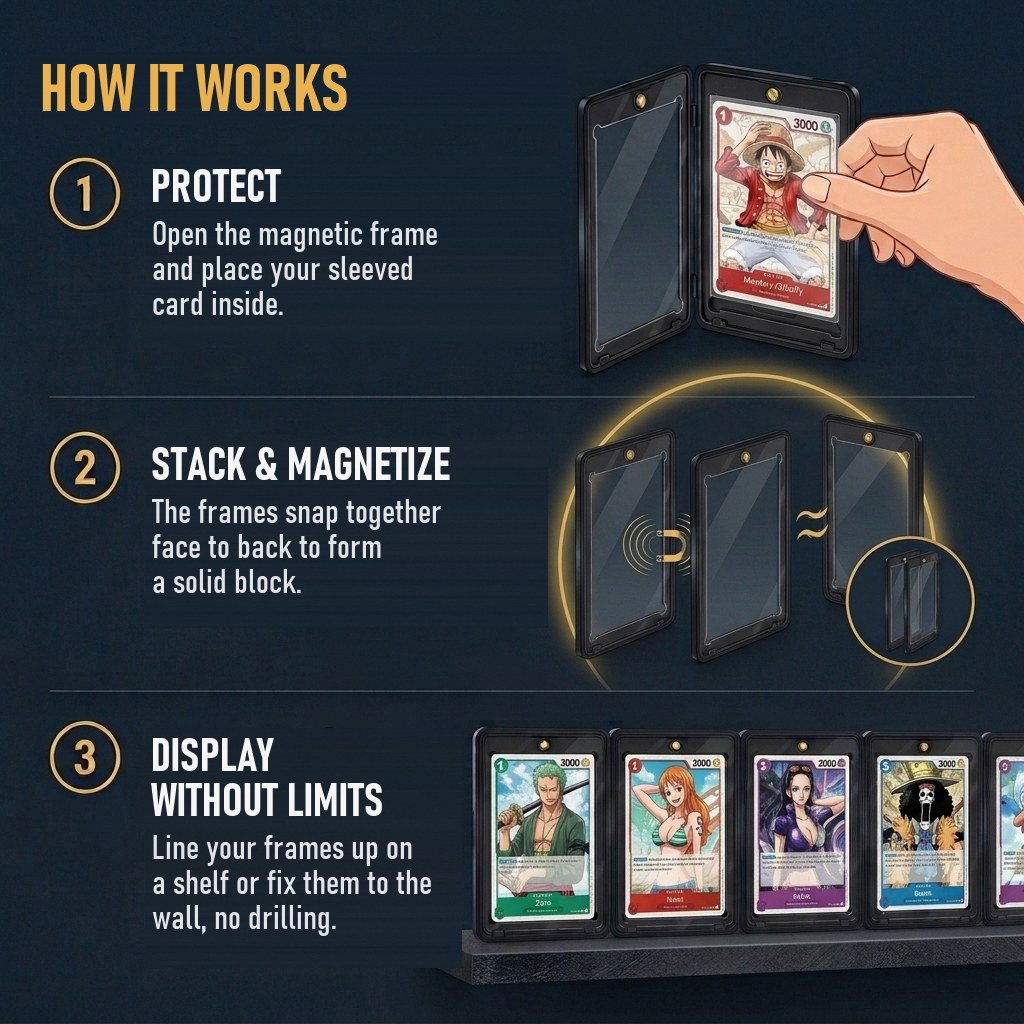
For the third tier of your sort, the logic changes: you are no longer after density but security. A valuable card in a binder goes through every page turn, and a card in a bare toploader is still exposed to knocks on the edge and dust entering through the opening. A one-touch frame locks the card between two rigid faces: it can no longer bend or slide, and you can look at it without taking it out.
Our magnetic one-touch frame, in aluminium with double glazing, comes in black or white at 24.80 € each, with the third one free when you buy two. For a large collection, its strength is modularity: frames snap together face to back to form a stable stack, stand upright on a shelf like books, and attach side by side on a wall. You store and display with the same object. If your centrepieces are graded, a PSA slab compatible version is available at 34.80 €, sold empty.
The routine never changes: the card goes into a sleeve first, then into the frame, which you stack or display. No glue, no screws, and the card can be removed at any time, which matters the day you want to check it, have it graded or sell it.
Humidity, light, heat: where should you keep your collection?
Even the best storage cannot save a collection kept in the wrong place. The three enemies are well known: humidity, which makes cards warp and can leave stains; direct sunlight, which fades inks and foils over the months; and temperature swings, which make both problems worse. Japanese cards, with their textured and glossy finishes, deserve the same care as any valuable card.
The ideal spot is a temperate living room or bedroom, away from windows, radiators and cold outside walls. A cupboard or closed shelf works very well for boxes and binders. Avoid cellars, attics, garages and bathrooms, even for bulk cards: those are the places where a collection deteriorates without anyone noticing.
For displayed cards, the rule is indirect light: a wall that does not face the sun, ambient lighting rather than a spotlight right next to the frame. Also check your boxes and binders a few times a year: a card that starts to warp is a sign of a humidity problem best fixed early.
How do you combine storage and display without multiplying supports?
A large collection does not need to be fully on show, but the pieces you are proud of deserve better than a drawer. The most space-efficient solution is rotation: most valuable cards stay stacked in their frames on a shelf, and a selection goes up on the wall. Since the frame is the same in both cases, changing the selection takes seconds.
For the wall, the adhesive magnetic strip means no drilling: you stick it once, the frames attach side by side and can be moved whenever you like. It comes in 1 m at 15 € or 3 m at 29 €, so you can start with one row and extend the wall as the collection grows. Single cards and frames share the same shipping cost, 4.20 €, free from 30 €, and shipping is only paid once per order.
Finally, keep a simple inventory, a spreadsheet is enough: card code, version, condition, location (box, binder, frame, wall). It is the tool that makes a large collection truly manageable, and it is also what an insurer or a buyer will ask for the day you want to insure or sell part of your cards.

To store a card collection, do not look for a single solution: sort it into three tiers, keep bulk cards upright in rigid boxes, the cards you browse sleeved in a stitched-page binder, and your valuable pieces in a one-touch frame you can stack or display. Keep everything in a temperate room, away from sunlight and humidity, and maintain an inventory. Your next concrete step: take out your ten best cards, sleeve them and give them a frame, because that is where most of your collection's value lies.
Frequently asked questions
Can you store valuable cards in a binder?
Yes, with a stitched-page binder and PVC-free pockets, the card being sleeved. But every page turn exposes it, and a binder will not stop a bend if it is dropped. For important pieces, rigid protection such as a one-touch frame is safer.
Do all cards need a sleeve?
Not necessarily for commons kept in a box and rarely handled. However, any card going into a binder, a toploader or a frame should be sleeved first. The sleeve protects the surface from scratches and rubbing.
Is it better to store cards upright or flat?
Upright, in most cases. A flat stack puts all the weight on the bottom cards, and a binder lying flat under other objects warps. Boxes, binders and frames should all be stored vertically, like books.
Where should you never store a card collection?
Avoid cellars, attics, garages, bathrooms and windowsills. These are the places where humidity, heat and sunlight vary the most. A cupboard in a temperate living space does a much better job.
Read next

Authenticity and condition
Online card selling scams: spot the traps and buy safely
Online card selling scams: the 8 most common traps, the warning signs to watch for and a simple method to buy your cards safely.
November 21, 2026

Authenticity and condition
One Piece card centering: how to measure it and what it does to value
Centering affects a One Piece card's grade and price. How to measure it, how to read it on a listing photo, and when it barely matters at all.
November 21, 2026

Authenticity and condition
One Piece card sleeve size: the right fit and how to sleeve properly
One Piece cards measure about 63 × 88 mm: use standard or perfect fit sleeves, never small ones, and sleeve them without forcing. Here is how.
November 20, 2026