
One Piece card centering: how to measure it and what it does to value
Published on November 21, 2026 · 7 min read

Key points
- One Piece card centering describes the balance of the printed borders, left against right and top against bottom. It is written as a ratio, with 50/50 meaning perfect centering.
- Centering is a manufacturing trait present the moment a booster is opened: it does not worsen over time, but no handling or treatment can correct it.
- In grading, poor centering can cap a card's grade even when its corners, edges and surface are flawless. The front is generally judged more strictly than the back.
- For a display card, slight off-centering matters little. For a card you plan to grade or resell as a high-end piece, check the centering on a photo before you buy.
You have spotted a beautiful Japanese One Piece card, a parallel or a SEC, and on closer inspection the left border looks wider than the right one. Or you are thinking about grading a card and keep reading that centering can make or break the result. It is a fair question: does a shift of a fraction of a millimetre really change what a card is worth, and should it worry you before you buy?
The short answer: centering matters a lot for grading and for high-end cards, and very little for a card you buy simply to enjoy on display. In this guide you will learn how to measure it in two minutes, how to read a ratio such as 55/45 or 70/30, when it genuinely affects price, and how to spot poor centering on a photo before you place an order.
What does centering mean on a One Piece card?
Centering describes where the print sits on the card stock. On a perfectly centered card, the outer borders are equal on the left and right, and again at the top and bottom. When the cutting of the print sheets is slightly off, the artwork and frame slide to one side: one border gets wider, the opposite one gets thinner. That is what collectors call off-centering.
It is expressed as a ratio between two opposite borders. 50/50 means perfect balance. 60/40 means one border takes up 60% of the combined width of the two edges and the other 40%. The further the first number moves from 50, the more visible the shift becomes to the naked eye. You measure the horizontal and vertical axes separately, on the front and then on the back, which gives four ratios per card.
The key point: centering is decided at the factory. An off-center card is off-center the moment the booster is opened, however carefully it is stored afterwards. That is why it is kept apart from condition in the strict sense, meaning corners, edges and surface, which depend on handling and storage.
How can you measure a card's centering yourself?
You do not need professional tools for a first estimate. A ruler marked in half millimetres, a magnifier or simply a straight smartphone photo will do. What matters is shooting the card perfectly flat and head-on, with no angle: the slightest perspective distorts the borders and can make a well-centered card look off.
On a zoomed photo you can also count the pixels of each border, which is often more accurate than a ruler laid on a sleeved card. For cards whose artwork runs almost to the edge, as many parallels do, rely on the visible outer border and on the fixed layout elements: the cost, the power and the effect text box.
- Lay the card flat on a plain, contrasting background under even light.
- Photograph it straight on, with the lens parallel to the card.
- Measure the left and right borders, then the top and bottom borders.
- Work out the share of the wider border: wider border divided by the sum of both borders.
- Repeat on the back, whose centering can differ from the front.

Does centering really change a card's value?
Yes, but not in the same way for every use. For an everyday card meant for play or set completion, the effect is small: nobody pays much more for a perfectly centered common. For a collector piece, whether a parallel, SEC, SP or manga rare, centering becomes a way to rank copies, because demanding buyers compare several copies of the same card and keep the most balanced one.
The clearest gap shows up on graded cards. For an identical card, the grade sets much of the price, and centering can stand between a card and the top grade. A well-centered raw card is therefore easier to resell as a grading candidate, which supports its value even before it goes anywhere near a grading company.
On the other hand, never pay a premium because a listing claims a card is well centered unless you have checked it yourself on the photo. Centering is a quality you demonstrate, not a selling point you simply assert.
| Use of the card | Weight of centering | What to check |
|---|---|---|
| Play or set completion | Low | Overall condition is enough |
| Framed display | Moderate | A shift visible to the naked eye on the front |
| Resale of a rare raw card | High | Front and back on a sharp photo |
| Grading | Very high | All four ratios and the chosen company's tolerance |

Why does centering weigh so heavily in grading?
Grading companies assess a card on four criteria: centering, corners, edges and surface. The final grade is not a generous average: the weakest criterion often drags the whole result down. A card with perfect corners but clearly off-center can therefore have its grade capped, and no amount of later care will change that.
Each company publishes its own centering tolerances, separate for the front and the back. The back is generally judged more leniently because it is looked at less. Before sending a card, check the official guidelines of the company you have chosen and compare them with your measurements: it is the simplest way to avoid paying for a grading that will not deliver the grade you hoped for.
Centering is also the only criterion you can assess reliably at home. Micro-scratches or slight edge whitening can escape the eye, whereas a border ratio can be measured. That makes it the first filter to apply before selecting a card for grading.

Are Japanese cards better centered?
It is a common belief, but it does not hold as a general rule. Centering varies from one print run to another, from one sheet to another, and sometimes from one card to the next in the same booster. A Japanese set can produce perfectly centered copies as well as clearly shifted ones. What sets Japanese cards apart is rather their finish and printing, which is a different topic from centering.
The practical takeaway is simple: judge each copy, never a reputation. On the most sought-after cards, especially parallels and SECs, compare several listings of the same card. A centering gap between two copies in the same condition can justify picking one over the other, even at a slightly higher price.
Cards with extended artwork hide slight off-centering better to the eye, but it remains measurable. Cards with a crisp frame, like many commons and rares, give away the smallest shift at first glance.

How do you spot poor centering before buying remotely?
When you buy a card from Japan without holding it, the photo is your only instrument. A good listing photo shows the whole card, head-on, with all four edges visible. If the card is shot at an angle, inside a thick toploader or cropped tight around the artwork, centering cannot be judged properly.
On our single Japanese cards, take the time to enlarge the photo and compare opposite borders before you confirm. If the card is headed for grading, favour copies whose front looks balanced on both axes, and accept that some uncertainty remains as long as the back is not shown.
If a listing does not let you judge, do not fill the gap with optimism. For a display card the stakes are low and you can go ahead calmly. For an expensive card meant for grading, it is better to wait for a better photographed copy than to pay for uncertainty.
- Is the whole card shown and photographed head-on?
- Do the left and right borders look equal?
- Do the top and bottom borders look equal?
- Is the back shown, or would you have to accept it unseen?
- Does the intended use, display or grading, justify being strict?
Can a slightly off-center card still be displayed?
Absolutely. For a card bought out of love for a character or an illustration, slight off-centering spoils nothing: in a frame, the eye goes to the artwork, not to the width of the borders. Accepting imperfect centering often lets you choose a more beautiful or rarer card for the same budget, which is a perfectly rational trade-off for a display.
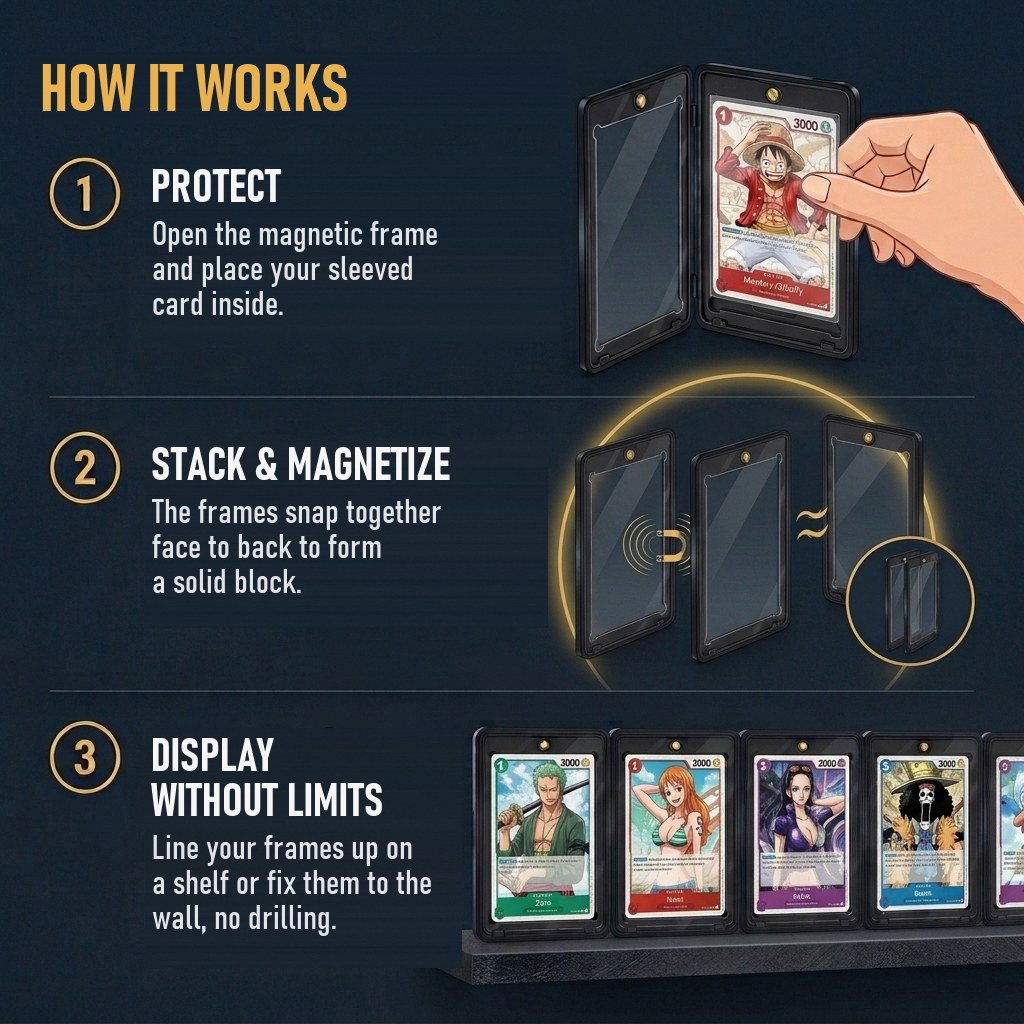
Our magnetic one-touch frame in aluminium, with double glazing, protects a sleeved card in black or white for €24.80 each, with the third one free when you buy two. Its even border around the card visually softens a small print shift. The frames snap together face to back to stack, stand upright like books and attach side by side to the wall with the adhesive magnetic strip, no drilling needed.
Just keep in mind that an off-center card bought for display will resell as a collector card rather than as a grading candidate. If you paid accordingly, you have lost nothing: you chose the artwork over the border.
The verdict is clear: centering is a decisive criterion for grading and for rare pieces you intend to resell, and a secondary detail for a card meant for your display. Measure it on a straight photo, think in border ratios, check the grading company's guidelines before sending anything, and only accept a premium for centering you have actually verified. Your next concrete step: browse our single Japanese cards, enlarge the photos of the ones you like and apply the thumb test before choosing. Shipping for cards is €4.20, free from €30.
Frequently asked questions
What centering do you need for the top grade?
Each grading company publishes its own centering tolerances, which differ for the front and the back. The front must be close to balanced, while the back is judged more leniently. Check the official guidelines of the company you choose before sending your card.
Is centering part of the A, B or C conditions?
Generally not: these conditions mainly describe wear, such as scratches, edge whitening or corner damage. A card in A condition can therefore be off-center. Rely on the photo to judge centering.
Can an off-center card be corrected?
No. Off-centering comes from the factory cut, and any attempt to trim the card damages it and makes it ineligible for grading. An off-center card is kept, displayed or resold as it is.
Should you avoid buying an off-center One Piece card?
Not necessarily. If the card is for display or personal enjoyment, slight off-centering matters little and can sometimes mean a lower price. If you are aiming for grading or a high-end resale, choose a copy whose centering you have checked.
Read next

Authenticity and condition
Online card selling scams: spot the traps and buy safely
Online card selling scams: the 8 most common traps, the warning signs to watch for and a simple method to buy your cards safely.
November 21, 2026

Authenticity and condition
One Piece card sleeve size: the right fit and how to sleeve properly
One Piece cards measure about 63 × 88 mm: use standard or perfect fit sleeves, never small ones, and sleeve them without forcing. Here is how.
November 20, 2026

Authenticity and condition
How to store a card collection: binder, box or frame, which is best?
Binder, box or one-touch frame: a three-tier method to store a large card collection with no bends, no humidity damage and no fading.
November 20, 2026