
Protect a One Piece card: sleeve, toploader or one-touch, what really works
Published on November 16, 2026 · 7 min read
Key points
- To protect a One Piece card, the foundation is a clear, PVC-free sleeve in standard size, applied before any rigid holder.
- A toploader is mainly for storage and shipping, while a closed magnetic one-touch is better suited to long-term keeping and displaying valuable cards.
- Humidity, direct sunlight and heat damage a card even when it is protected: store it in a dry, temperate room away from windows and radiators.
- Protection should match the card's value: sleeve and binder for playing cards, sleeve and one-touch for SR, SEC, parallels and manga rares.
You have just received a Japanese One Piece card you love, maybe an SR, a parallel or a SEC, and you want it to stay exactly as it is. The question sounds simple: do you need a sleeve, a toploader, a one-touch, or all of them? Every collector has a method, and many find out too late that the wrong protection can itself leave marks on a card.
Here is the short answer: a sleeve for every card that matters, then a rigid holder matched to how you use it. A toploader for storing and shipping, a magnetic one-touch for keeping and displaying a valuable piece. The rest of this guide explains why, which protection fits which level of value, the hidden enemies that are humidity, light and heat, and the mistakes that cost a card its condition grade.
Why is the sleeve the essential first layer?
A sleeve is a thin, soft plastic pocket that wraps the card. It will not stop an impact, but it prevents most everyday damage: fingerprints, dust that scratches the surface, and micro-friction when the card slides into a rigid holder. It is the layer that separates the card from everything else, which is why it always comes first, whatever you do next.
Not all sleeves are equal. Choose clear models that are PVC-free and acid-free, in the right size: a sleeve that is too loose lets the card move, one that is too tight puts pressure on the corners as you insert it. One Piece Card Game cards, Japanese and English alike, use the standard card size, so standard sleeves fit them without any adjustment.
For a valuable card, many collectors double-sleeve: a snug inner sleeve, often called perfect fit, slid on from the top, then a regular sleeve added the other way round over it. The card is then sealed on both ends against dust and ambient air, which makes an excellent base before a toploader or a frame.
- Clear and PVC-free, so it does not yellow or stick to the surface
- Acid-free, for storage over many years
- Standard game size, neither too loose nor too tight
- New and clean: a reused sleeve can carry abrasive dust
- Inserted while holding the card by its edges, never pushing on a corner
Toploader, one-touch or card saver: what is the real difference?
Once sleeved, a card needs a rigid holder if it is going to be stored for a long time, shipped or displayed. There are three families. The toploader is a rigid pocket open on one side: affordable, handy for box storage and for posting a card. The card saver is semi-rigid and mostly used when submitting a card for grading, because grading companies find it easier to handle.
The one-touch is a closed, two-part case that holds the card flat, usually with magnets. Dust and fingers can no longer reach the card, and it presents like a genuine collector's piece. It is the logical choice for a card you want to keep for years and actually look at, not just file away at the bottom of a box.
In practice, you are not choosing one format for the whole collection, you are matching each holder to its use. Toploaders for stock and shipping, card savers for grading, one-touch cases for the cards that deserve to be seen. The table below sums up what each protection really does.
| Protection | Scratches | Bending | Dust | Best use |
|---|---|---|---|---|
| Sleeve only | Yes | No | Partly | Play, sorting, first layer |
| Toploader | Yes, with a sleeve | Yes | Partly, open on one side | Box storage, shipping |
| Card saver | Yes, with a sleeve | Partly | Partly | Grading submissions |
| Magnetic one-touch | Yes | Yes | Yes, closed case | Long-term keeping, display |
Which protection should you choose based on the card's value?
The right rule is proportion. A common or a deck card only needs a sleeve and a binder or deck box. The more a card matters to you, through its rarity, its artwork or its price, the more it deserves a closed holder. There is no need to case every UC, but a SEC, a parallel or a manga rare should never sit bare in a drawer.
The same logic applies to cards bought in Japan. A card listed in A condition, close to mint, keeps its value as long as it keeps its condition: protection is the simplest way to stop it sliding to A- or B. For a card graded B at purchase, the goal is to keep existing marks from getting worse. Either way, protection is a small cost compared with the value it preserves.
- Playing card or common: sleeve, then deck box or binder
- Rare card you are keeping: sleeve then toploader, stored upright in a box
- Collector's piece (SR, SEC, parallel, alternate leader, manga rare): sleeve then magnetic one-touch
- Graded card: the slab already protects it, a slab-compatible frame lets you display it
Humidity, light, heat: what are a card's real enemies?
A card that is well protected against impacts can still deteriorate if it is stored in the wrong place. Humidity is the first risk: the card stock absorbs moisture from the air and can bend, which collectors call curl. Holographic and parallel cards are often more sensitive to it, because their shiny layer does not react the same way as the card stock underneath.
Direct sunlight fades inks over time, even behind glass. Heat speeds up both effects and can make some low-quality sleeves stick to the surface. Keep your cards in a dry, temperate room, away from a radiator, a very sunny window or a damp basement.
A small moisture-absorbing sachet in your storage box is a simple, inexpensive precaution. And if a card arrives slightly curved, leave it flat for a few days under a light weight, inside its sleeve, rather than trying to straighten it by hand, which risks creasing it.
How do you display a One Piece card without damaging it?
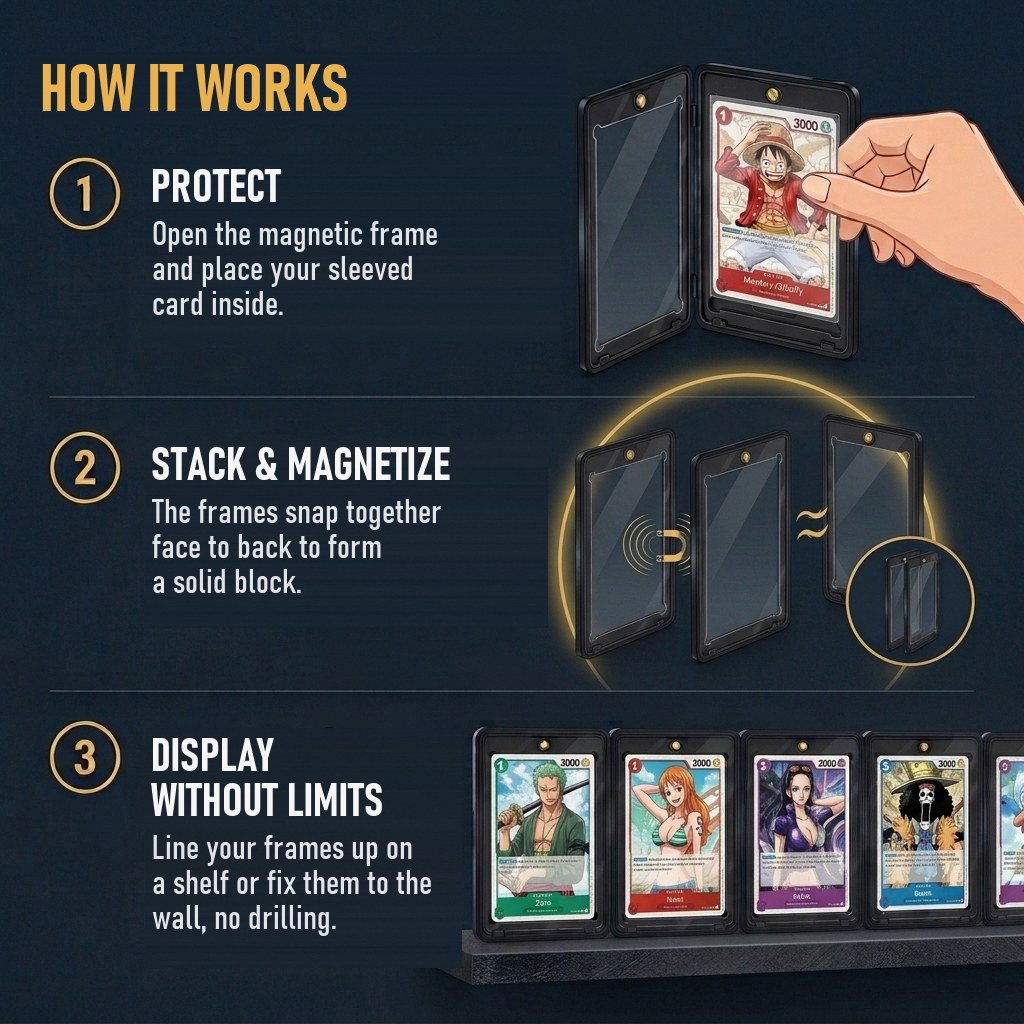
Displaying a card means accepting that it will be seen, approached, moved and exposed to the air in the room. The solution is a holder you never need to open. Our magnetic one-touch frame is made of aluminium with double glazing, in black or white: the card, slipped in while sleeved, is held flat and stays sealed from dust.
The magnetic format also changes how you store. The frames snap together front to back to stack, stand upright on a shelf like books, and fix side by side on a wall with an adhesive magnetic strip, no drilling needed. The same card can move from storage to display without ever leaving its case, which removes handling, the main cause of wear.
On budget, the frame costs €24.80 each, with buy 2 get the 3rd free, and shipping for cards and frames is €4.20, free from €30. For a card that matters, it is lasting protection rather than an accessory you keep replacing.
How do you store a growing collection without constant handling?
The real danger for a collection is not the day you put a card away, it is the hundredth time you take it out to show someone. Every handling is a chance to rub a corner or leave a mark. So organise your collection in tiers: playing cards in deck boxes, rares in toploaders inside a storage box, centrepieces in one-touch cases.
For a binder, pick PVC-free pages, ideally side-loading so cards do not slip out, and do not overfill it: a packed binder puts pressure on the cards closest to the spine. Store it upright, never flat under a stack of books.
For framed cards, an expandable wall saves you from rearranging everything with each new purchase. The adhesive magnetic strip comes in 1 m for €15 and 3 m for €29: you add a frame next to the others, with no tools, and change the order as often as you like.
Which mistakes damage a card even when it is protected?
Most damaged cards in a collection were not ruined by an accident but by a habit. The mistakes below come up again and again, and each one can cost a card a condition grade when it was perfect on arrival.
The sneakiest is tight storage: toploaders crammed together, a box that is too small, a rubber band around a stack. Constant pressure ends up marking the edges and bending the cards. Protection only helps if it leaves the card alone, flat or upright, under no strain.
- Sliding a bare card into a toploader: it gets scratched going in and out
- Sealing a toploader with tape, which eventually touches the sleeve or the card
- Holding a stack of cards together with a rubber band
- Keeping old PVC pockets that yellow and stick
- Displaying a card in direct sunlight or near a radiator
- Taking a valuable card out regularly to show it instead of displaying it in a closed frame
The verdict is clear: a sleeve for every card that matters, a toploader for storing and shipping, a one-touch for keeping and displaying your best pieces, all in a dry, temperate room out of direct sunlight. Start with your three or four most valuable cards: sleeve them, put them in a magnetic frame, and let the rest of the collection follow as you buy. A card protected from day one remains the best guarantee of keeping its condition, and the pleasure of looking at it.
Frequently asked questions
Should I sleeve a card before putting it in a toploader?
Yes, always. A toploader is rigid and its inside can scratch a bare card as you insert it. The sleeve acts as a sliding layer and also seals the card against dust.
Is a binder enough to protect One Piece cards?
For playing cards or common rares, a PVC-free binder stored upright works well. Your most valuable pieces remain exposed to spine pressure and handling, so a toploader or one-touch is the better choice.
Does a glazed frame protect a card from sunlight?
Do not rely on glass to block direct sunlight. Double glazing protects against dust, fingers and knocks, but placement is what decides: choose a wall that does not get prolonged direct sun.
Can I display a PSA graded card in a magnetic frame?
Yes, with a frame designed for slabs. Our PSA slab-compatible version costs €34.80, sold empty, and stacks or mounts on the wall just like the standard frame.
Read next
Authenticity and condition
Online card selling scams: spot the traps and buy safely
Online card selling scams: the 8 most common traps, the warning signs to watch for and a simple method to buy your cards safely.
November 21, 2026

Authenticity and condition
One Piece card centering: how to measure it and what it does to value
Centering affects a One Piece card's grade and price. How to measure it, how to read it on a listing photo, and when it barely matters at all.
November 21, 2026
Authenticity and condition
One Piece card sleeve size: the right fit and how to sleeve properly
One Piece cards measure about 63 × 88 mm: use standard or perfect fit sleeves, never small ones, and sleeve them without forcing. Here is how.
November 20, 2026