
Magnetic one touch card holder: the best protection for display
Published on November 17, 2026 · 8 min read

Key points
- A magnetic one touch is a rigid two-part case held shut by magnets. It keeps a card flat without screws or pressure, protecting it while leaving it fully visible.
- For display, a one touch beats a toploader, which is open on one side, and a binder, which hides the card: it keeps dust out and holds the card perfectly straight.
- The right method is to slide the card into a snug sleeve before placing it in the one touch, with clean hands, on a flat surface, and never to force the case shut.
- A one touch protects but certifies nothing: it adds no value to a card and does not shield it from prolonged direct sunlight or humidity.
You finally have the card you were after: a parallel of your favourite character, a Japanese SEC, an alternate art leader. Now comes a very practical question: how do you show it off without damaging it? Left in a binder, it stays hidden. Placed bare on a shelf, it is exposed to dust, fingerprints and knocks. And the toploader, handy as it is for shipping, was never designed as decoration.
Our answer is clear: for display, the magnetic one touch is the best protection a collector can get, even before grading. It closes fully, keeps the card flat, stands upright and mounts on a wall. Here is what it really is, how it compares with other protection, how to put a card inside without risk, and the mistakes that cancel out all its benefits.
What is a magnetic one touch card holder?
A one touch is a rigid case made of two clear panels that close over each other around a card. The name comes from how you use it: it opens and closes in a single movement, with no screws, no clips and no tape. In the magnetic version, magnets built into the frame hold the two halves together. They are strong enough to keep the case shut and gentle enough to let it open without tools.
Compared with old screw-down holders, the difference matters. A screw clamps, and an overtightened screw can dent a card or make it bow. A magnet closes the case without crushing what is inside: the card sits in a recess shaped for it, and the pressure stays the same every time you close it. That is what makes it suitable for cards you want to keep in near mint condition.
Our magnetic one touch frame follows this principle with an aluminium border and double glazing, in black or white. The border gives the whole thing structure, and the panes let you see the card from both sides. There is also a deeper version designed to hold an already graded PSA slab.

Why is it the best protection for displaying a card?
Displaying a card means exposing it to everything that wears it down: dust that settles and scratches, fingers that leave greasy marks, small knocks when you move it, and humidity that eventually makes it bow. A magnetic one touch deals with all four risks at once. It is closed on all four sides, it prevents direct contact with the card surface, and its rigidity stops the card from bending.
It also keeps the card perfectly flat. A card leaning against a wall or sitting in a loose toploader often develops a slight curve over time, especially if it has a glossy finish. In a well fitted one touch, it is supported across its whole surface. For a Japanese card listed as A or A- condition by the original shop, that is exactly what you need to make sure its condition stays put.
Finally, it is made to be looked at. A toploader still looks like technical packaging, whereas a one touch frames the card, lifts it off the background and presents it as a real piece. That double role, protecting like a case and presenting like a frame, is what puts it ahead of every other option as soon as a card leaves the binder.

One touch, toploader, binder or slab: which one for which use?
Each type of protection has its place. A sleeve is the foundation: a thin, soft pouch that protects the card surface from scratches and fingerprints. It does nothing against bends or knocks. A toploader is a rigid sleeve open on one side. It is perfect for posting a card or storing it in a box, but it lets dust in and the card can slide around.
A binder suits large collections and cards you browse, not the ones you want to show. A graded slab brings an official grade and a sealed case, but it is expensive, often involves weeks of waiting and only makes sense for certain cards. The table below sums up the criteria that matter when your goal is display.
The conclusion is simple: a sleeve for every card, a toploader for transport, a binder for the everyday collection, a one touch for the cards you want to see every day, and a slab for the few pieces that justify grading. A slab can itself be displayed in a suitable frame.
| Protection | Closed on 4 sides | Rigidity | Designed for display | Best use |
|---|---|---|---|---|
| Sleeve only | No | Soft | No | Foundation of all protection |
| Toploader | No, open on one side | Rigid | Barely | Shipping and storage |
| Binder | Depends on model | Depends on model | No | Large collection, browsing |
| Magnetic one touch | Yes | Rigid | Yes | Everyday display |
| Graded slab | Yes, sealed | Very rigid | Yes | Graded, certified piece |
How do you put a card in a one touch without damaging it?
Handling takes a minute, but it is the only moment when the card is truly vulnerable. Most defects found on supposedly protected cards come from this step: a speck of dust trapped against the surface, a corner crushed by forcing the case shut, a fingerprint on a glossy finish. Get into the habit of repeating the same moves, in the same order, every time.
The principle has three stages, shown below: protect the card, place it, then display it. Nothing complicated, on one condition: never force anything. If the case does not close on its own under the pull of the magnets, something is sticking out or the protection you chose is too thick.
- Wash and dry your hands, then work on a flat, clean, soft surface such as a playmat or a microfibre cloth.
- Slide the card into a snug sleeve from the top, without bending the corners.
- Open the one touch and gently remove dust from the inside of the panes by blowing or with a microfibre cloth.
- Lay the card centred in its recess, holding it by the edges.
- Close the case by bringing the two halves together flat: the magnets do the rest, with no pressing needed.
- Check against the light that no dust or hair is trapped before putting the card on display.
Which mistakes damage a card even inside a one touch?
A one touch protects against a lot, but not everything. The first mistake is location. A card displayed in full sun behind a window will lose some of its brightness over time, whatever protects it. A damp room or a cold wall encourages bowing. The best place is an interior wall, away from heat sources and out of direct light.
The second mistake is fit. A sleeve that is too thick, a double sleeve or a badly centred card forces you to push the case shut, and the pressure then lands on the edges and corners. Conversely, a card floating in a case that is too big slides around every time you move it. The third mistake is handling it too often: opening the frame to show the card to every visitor multiplies the chances of damaging it.
Remember too that a one touch repairs nothing. If the card arrives with edge whitening or a slight curve, the case will preserve it exactly that way. Check the card on arrival, note its condition, then put it in. The frame locks in the condition, it does not improve it.
How do you display several one touch cards on a wall or shelf?
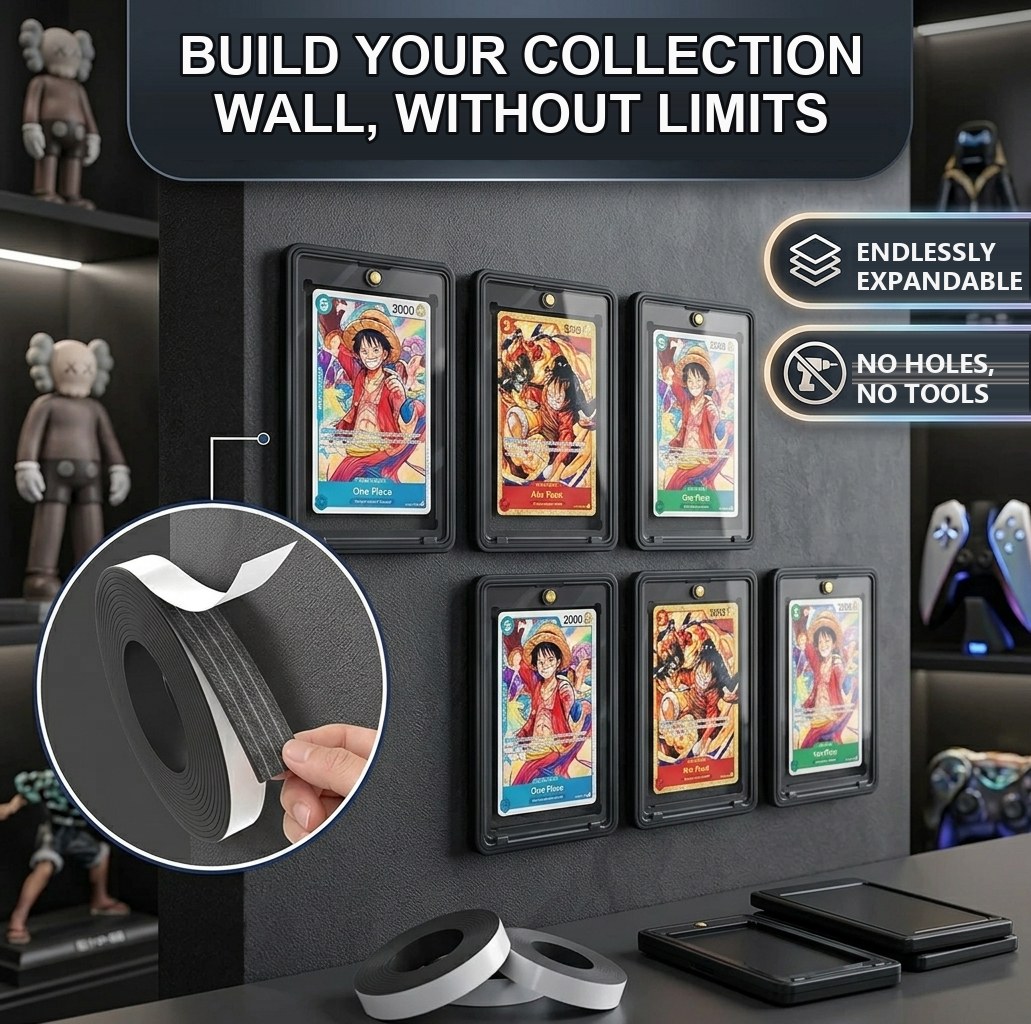
A single card stands on a shelf like a small picture. As the collection grows, the real question becomes organisation. Our frames attach to each other magnetically, face to back: you can stack them into a compact pile for storage, or line them up upright on a shelf like books.
For walls, the neatest solution is the adhesive magnetic strip. You stick it on once, with no drilling, and the frames attach to it side by side. To extend the row, just add more cards, or swap them around whenever you like. The strip comes in 1 m for €15 and 3 m for €29, so you can start small and lengthen the wall later.
Plan the layout like a showcase: one row per character, per set or per leader colour, alternating black and white frames, or one central card surrounded by its crew. Leave a little space between frames so each card can breathe, and keep the row at eye level.
Which cards deserve a one touch, and which colour should you pick?
Not every card needs a frame. A common from your deck is perfectly happy in a sleeve inside a binder. A one touch makes sense for the cards you want to see and keep for a long time: a parallel, a Japanese SR or SEC, an alternate art leader, a P promo with a personal story, or a card you are giving as a gift. The criterion is not just price, it is the place the card holds in your collection.
Choose the colour according to the wall and the card. Black brings out light artwork and cards with bright borders, for a gallery look. White blends into a light interior and lightens a busy wall. Nothing stops you mixing them, but a single colour wall usually looks tidier.
On budget, our one touch frame costs €24.80 each, and when you buy two, the third is free. A PSA graded card can be displayed in the slab compatible version at €34.80, sold empty. Shipping for cards and frames costs €4.20, free from €30, and is only paid once per order.
For displaying a card, the magnetic one touch is the most complete protection: closed, rigid, pressure free and designed to be looked at. Keep toploaders for shipping, binders for the everyday collection and grading for the few pieces that justify it. Your next step: pick the card that deserves to be seen, slide it into a snug sleeve, place it in a black or white one touch and hang it on a wall out of direct sunlight. Our magnetic frames and our single Japanese cards are made to go together.
Frequently asked questions
Should I sleeve a card before putting it in a one touch?
Yes, it is recommended. The sleeve protects the surface while you put the card in and prevents any rubbing against the pane. Choose a thin, snug sleeve: a double sleeve can stop the case from closing without force.
Does a magnetic one touch protect against UV?
That depends on the model and on what its manufacturer states, and no case makes a card fully immune to prolonged sunlight. Real protection comes from location: a wall out of direct light.
Does a one touch increase a card's value?
No. It preserves the card's condition, which protects its value, but it certifies nothing. Only grading by a recognised company assigns an official grade.
Can I display a PSA graded card in a magnetic frame?
Yes, with a frame made for the thickness of a slab. Our PSA slab compatible version is sold empty at €34.80 and displays like the other frames, standing up or on the wall.
Read next

Authenticity and condition
Online card selling scams: spot the traps and buy safely
Online card selling scams: the 8 most common traps, the warning signs to watch for and a simple method to buy your cards safely.
November 21, 2026

Authenticity and condition
One Piece card centering: how to measure it and what it does to value
Centering affects a One Piece card's grade and price. How to measure it, how to read it on a listing photo, and when it barely matters at all.
November 21, 2026

Authenticity and condition
One Piece card sleeve size: the right fit and how to sleeve properly
One Piece cards measure about 63 × 88 mm: use standard or perfect fit sleeves, never small ones, and sleeve them without forcing. Here is how.
November 20, 2026