
One Piece Robin card: the most sought-after Japanese versions
Published on November 13, 2026 · 7 min read

Key points
- The most sought-after One Piece Robin cards are the Japanese alternate art versions, marked AA or SP, which are rarer to pull than the base card.
- An SP card is generally harder to obtain than an AA. The AA remains the best option for building a consistent series around Nico Robin.
- For a Robin card meant for a frame, aim for condition A (near mint) or A- (very good): under glass, flaws show on shiny finishes.
- One Piece Card Game sets are released in Japan first, which often makes the Japanese version of a Robin card the collectors' reference.
You are looking for a One Piece Robin card and you find dozens of versions: commons, rares, alternate arts, SPs, starter deck cards, premium set cards. The same character shows up in almost every block of the game. Without a clear method, you end up paying collector prices for an ordinary illustration, or missing the version you actually wanted to frame.
The short answer: for a collection, go first for the Japanese alternate art versions (AA and SP), in condition A or A-, then pick the illustration that speaks to you rather than the hype of the moment. This guide gives you the method: reading a card code, comparing rarities, judging condition, setting a budget and displaying the card without damaging it.
Which Japanese Nico Robin cards are the most sought after?
The Robin cards that attract collectors most have one thing in common: an illustration that differs from the base version. In the One Piece Card Game, the same code can exist as a standard card and as a parallel, with alternate art, an extended frame or a shiny treatment. These versions, marked AA or SP, carry most of the demand, far more than the printed rarity alone.
In our current selection, Robin spans a wide range of sets: the ST01 starter deck, the OP04, OP05, OP09, OP12, OP14 and OP16 boosters, and the EB03 and EB05 extra boosters. The two SP versions available, EB05-016 and EB03-055, are typically the ones a collector puts at the centre of a display. The AAs offer a broader and more varied entry point.
Our clear view: do not hunt for the single best Robin in absolute terms. Look for the version whose art you love, in the rarity that fits your budget, and check condition before anything else. For a display, an AA in condition A beats a rarer but damaged version, because that is the card you will look at every day.
SP, AA or standard card: which rarity should you choose?
The printed rarity (C, UC, R, SR, SEC, L) tells you how often the base version is pulled. Parallel versions sit on top of that: the same card can have an AA version far harder to find than the original. That is why two Robin cards with the same printed rarity can have very different market values.
An SP is a special version inserted into a set, often with new artwork and a distinctive finish. It is generally rarer to pull than an AA and draws collectors who focus on one character. The AA, more accessible, remains the best option for building a consistent series around Robin, set after set.
The standard card still has value for play or to complete a binder, but it suits framing less. Its art is shared by a huge number of copies and stands out very little on a wall. For a display, the real question is not standard or parallel, it is AA or SP.
| Version | Artwork | Rarity when opening | Display appeal | Best for |
|---|---|---|---|---|
| Standard | Base version | Depends on printed rarity | Low | Players, complete binder |
| AA (alternate art) | Alternate drawing | Rarer than the base version | High | Character collection |
| SP | Special art, distinctive finish | Generally the hardest | Very high | Centrepiece of a display |
| Starter (ST) | Base or parallel version | Depends on the version | Medium | First purchase, nostalgia |
How do you read a Robin card code before buying?
Every card carries a code such as OP04-064: the prefix gives the set, the number gives its position in the list. OP stands for main boosters, EB for extra boosters, ST for starter decks, PRB for premium boosters and P for promo cards. This code is your best tool to avoid mixing up two Robin cards that look alike.
On our site, a _p1 or _p2 suffix marks a parallel version: not the base card, but an alternate illustration of the same code. One card can have several parallels, like EB05-010, which we carry in both _p1 and _p2, or OP16-092 in its two versions. Always compare the images, not just the code.
Finally, check the language: our cards are Japanese, with Japanese text. For a display, that is an aesthetic plus. If you want to play in a European tournament, check the event's language rules before building a deck around a Japanese version.
- Prefix: the set (OP, EB, ST, PRB, P)
- Number: the position in the set list
- Rarity: C, UC, R, SR, SEC, L, SP
- Suffix _p1 or _p2: parallel version with alternate art
- Condition: A, A-, B or C, as stated by the Japanese shop
Why choose a Japanese Robin card over an English one?
Sets are released in Japan first. A new Robin illustration is therefore available in Japanese before its English version, and some cards or promos remain specific to the Japanese market. For a collector, the Japanese version is often the reference, the one that was printed first.
Collectors often rate the print quality of Japanese cards very highly, and the Japanese text gives a more authentic look under a frame. On a wall, nobody reads the card effect: people look at the art, and the Japanese version often shows it off with a cleaner layout.
The downside is practical: buying directly in Japan goes through Japanese shops and platforms, with a language barrier, middlemen and fees that add up. That is exactly what we simplify with our Japanese cards: every card listed is genuinely for sale in Japan, bought to order and then shipped to Europe.

What condition should you aim for on a collectible Robin card?
The Japanese shop states a condition for every card: A (near mint), A- (very good), B (good, visible wear) and C (fair). For a card going into a frame, aim for A or A-. A scratch or a whitened corner shows under glass, especially on the shiny finishes of AA and SP cards.
Condition B has its place if you love the illustration and your budget is tight: the difference shows up close, much less from a distance on a wall. Condition C is better suited to play, a working binder or a placeholder card until you find a better copy.
If you are thinking about grading later, condition A is the only sensible starting point, with no guaranteed grade. Centring, surface, corners and edges are assessed by the grading company, and nobody can promise a result in advance.
- A: first choice for a frame or a grading project
- A-: excellent compromise for a display
- B: acceptable if the art matters more than perfection
- C: play, binder, or placeholder card

What budget should you plan and how do you decide?
We will not quote a precise value: the price of a Robin card depends on version, condition and timing, and it moves. What is reliable is the general order: a standard card generally costs less than an AA, which often costs less than an SP of the same character. Prices on our site are in euros, VAT included.
To decide well, start from the card's role. A centrepiece deserves an SP or an AA in condition A. A Robin series can mix several AAs from different sets. A first card can come from the ST01 starter, accessible and meaningful for anyone who discovered the game with the Straw Hat crew.
Also think about total cost: card shipping is €4.20 and free from €30, and you pay postage only once per order. Grouping a Robin, another card and a frame in one order is often smarter than multiplying shipments. Treat a collection purchase as a pleasure, not an investment: prices can go down too.
- Centrepiece: SP or AA, condition A
- Character series: several AAs, condition A or A-
- First purchase: starter version or a recent AA
- Group your purchases to get free shipping from €30
How do you protect and display your Robin card?
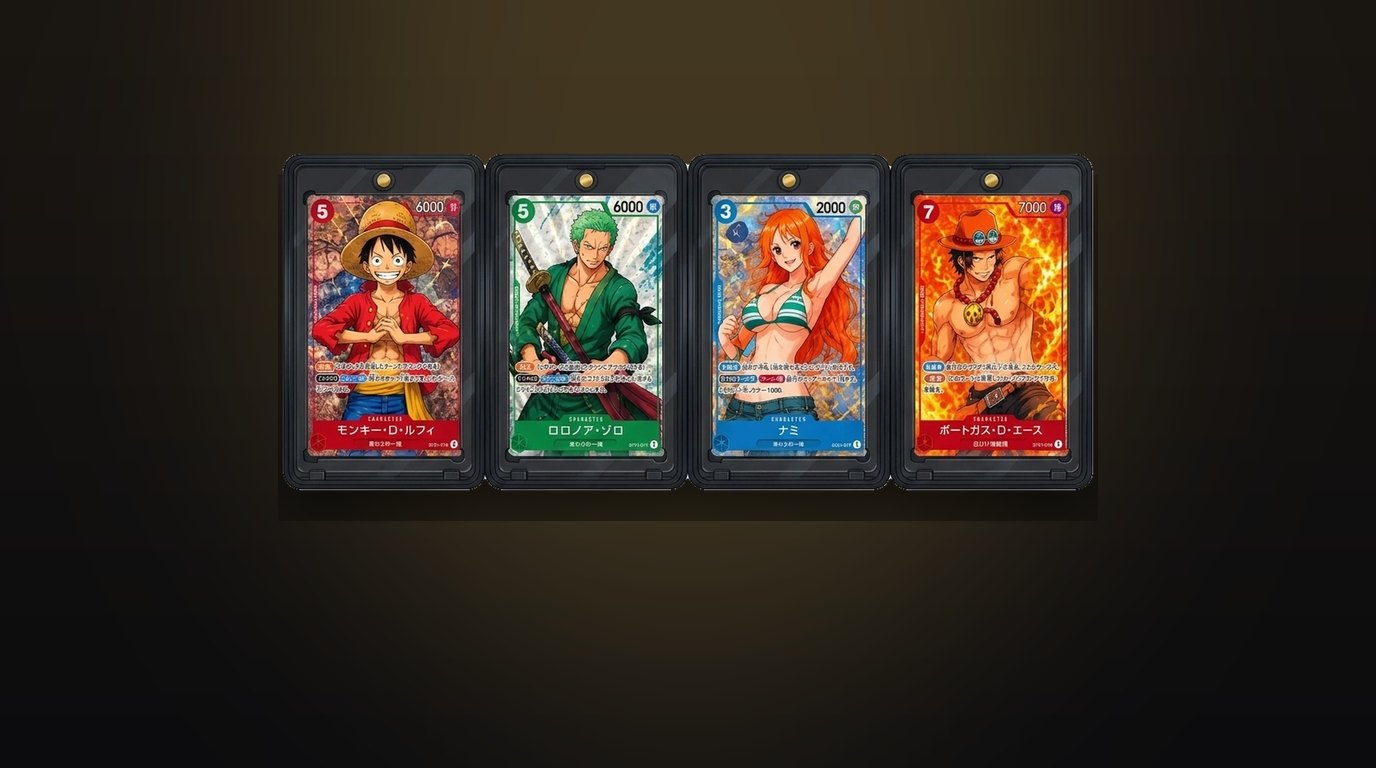
As soon as it arrives, slide the card into a sleeve, then into a rigid holder. For a card you want to see every day, our magnetic one-touch frame is the simplest solution: aluminium, double glass, black or white, €24.80 each, with the third one free when you buy two.
The frames snap together face to back to stack, stand upright like books, and attach side by side on the wall with an adhesive magnetic strip, 1 m for €15 or 3 m for €29, with no drilling. A Robin series on one wall tells the story of the character from one set to the next.
Avoid direct sunlight, which can fade colours over time, and prefer indirect lighting. If your card is already graded, the PSA slab compatible version at €34.80, sold empty, holds it in the same spirit and lines up with your other frames.
Verdict: for a collection, the One Piece Robin card to target is a Japanese alternate art version, AA to build a series, SP for the centrepiece, in condition A or A-. Read the code and the suffix before buying, decide the card's role before the budget, then protect it as soon as it arrives. Your next concrete step: browse our Japanese Nico Robin cards in stock, choose the art that speaks to you and add its magnetic frame to the same order.
Frequently asked questions
What is the rarest Robin card in the One Piece Card Game?
The hardest versions to obtain are generally the SPs and some alternate arts, which are rarer to pull than the base card. Exact pull rates are not published card by card. For a collection, art and condition matter as much as rarity.
What does AA mean on a Robin card?
AA stands for alternate art: the same card code with a drawing different from the base version. These versions are rarer to pull and highly sought after for display.
Can a Japanese Robin card be played in Europe?
The effects are the same, but the text is in Japanese. Language rules depend on the event, so check them before a tournament. For a collection or a display, language is no issue at all.
Is it better to buy a single Robin card or open boosters?
If you want a specific Robin, buying the single is the safest route. A Japanese display contains 24 boosters of 6 cards, and nothing guarantees the version you want is inside. Boosters are a pleasure to open, not a method to target one card.
Read next

Buying guides
Buy One Piece cards as singles: the math that beats opening boosters
Buying a single One Piece card usually costs less than opening boosters to chase it. Here is the calculation, the exceptions and a clear method.
November 13, 2026

Buying guides
Buying Japanese One Piece cards from Europe: the complete guide
Where to buy Japanese One Piece cards in Europe, what they really cost once delivered and how long they take: a clear method to buy without bad surprises.
November 13, 2026

Buying guides
Japanese or English One Piece booster: differences and which to choose
Japanese or English One Piece booster? Real differences in content, price, rarity and resale, and which version to pick for your goal.
November 13, 2026