
Curled or warped card: why it happens, how serious it is, how to prevent it
Published on November 19, 2026 · 7 min read
Key points
- A curled One Piece card is usually a foil card reacting to humidity: the paper core swells or dries out while the shiny foil layer on the front barely moves.
- A light curl that disappears after a few days lying flat in a protector is generally reversible and has little effect on condition, unlike a crease, which permanently breaks the paper fibres.
- To flatten a curled card, put it in a sleeve and a rigid holder, lay it flat under a light weight in a room with stable humidity, then wait: never use heat, water or reverse bending.
- The best prevention combines stable room humidity, a rigid holder that keeps the card flat such as a one-touch, and storage away from windows, radiators and damp rooms.
You pull a card from its booster or its envelope and it is no longer flat: the edges lift, the centre dips, the card looks like a roof tile. It is one of the most common worries among One Piece Card Game collectors, especially with foil cards, and a legitimate one: is a curled card damaged, has it lost value, can it be saved?
The short answer: in most cases, a curled card is not a ruined card. Curling comes from humidity, it is often reversible with patience and a gentle method, and it is easy to prevent. This guide covers the real causes, a simple grid to judge how serious it is, the safe way to flatten a card, and the storage and display habits that stop it happening.
Why do One Piece cards curl?
A trading card is a sandwich: a paperboard core, covered in print and varnish, and on foil cards, a thin metallic or plastic layer on the front. Paper is hygroscopic: it absorbs moisture from the air when humidity rises and releases it when humidity drops, swelling or shrinking slightly. The foil layer hardly reacts at all.
When the two sides do not move at the same pace, the card bends. In humid air, the paper back swells more than the shiny front and the card usually cups towards the front. In very dry air, the effect can reverse. That is why non-foil commons often stay flat while the SR, SEC, parallel or foil leader cards from the same booster curl.
Sudden changes of environment are the classic trigger: opening a sealed booster, a flight, moving from a heated room to a cold windowsill, storage next to a bathroom. A card shipped from Japan crosses several climates in a few days, so a slight curl on arrival is common and, most of the time, temporary.

Curled, warped or creased: how do you tell them apart?
Not everything that is not flat is a curl. Before you worry, identify the defect precisely, because severity and remedy change completely. Lay the card on a flat surface under raking light and look at it from the side, then tilt the front slightly.
A curl is a soft, even bend from one edge to the other, with no ridge. A warp is an irregular deformation, often at a corner or twisted, caused by pressure or crooked storage. A crease leaves a sharp line that catches the light: the paper fibres are broken and no method truly repairs them.
This sorting covers the vast majority of cases. If you hesitate between a strong curl and the start of a crease, look closely at the surface: a crease almost always leaves a visible mark in the reflection, even once the card is flat again.
| Defect | Look | Likely cause | Reversible? | Effect on condition |
|---|---|---|---|---|
| Light curl | Soft bend, no ridge | Humidity, foil layer | Usually yes | Low or none if it goes away |
| Strong curl | Tile shape, edges clearly raised | Lasting or repeated humidity | Often partly | Depends on what remains after resting |
| Warp | Irregular shape, bent corner | Pressure, crooked storage | Rarely fully | Often visible, can lower the grade |
| Crease | Sharp line catching the light | Forced bending | No | Permanent defect, much lower grade |

Does a curled card lose value?
It depends on what is left. A light curl that disappears once the card has rested flat generally changes nothing about its real condition: the fibres are intact, the surface is untouched. Many collectors see it as normal foil behaviour rather than a defect.
A strong, lasting curl is different. On a valuable card it shows in a display, it makes insertion into a rigid holder awkward, and it can weigh on the condition assessment, whether in the A, A-, B or C grades announced by Japanese shops or at a grading service. Exact criteria vary from one assessor to another, so assume a visible bend will be noticed.
The real danger is the wrong reaction. A curled card that someone tries to straighten by hand, with heat or by bending it the other way often ends up warped or creased, and then the loss is permanent. With a valuable curled card, the right approach is simple: force nothing, protect it and let time do the work.
How do you flatten a curled card without damaging it?
The method that works is slow and passive. The idea is to let the paper rebalance with stable room air while holding it flat so that it settles in the right shape. No direct handling of the bare card, no sudden moves.
Allow several days, sometimes longer for an old curl. Check from time to time without taking the card out of its protection. If the bend decreases, keep going; if it no longer changes after a long period, the deformation is set, and it is better to accept it than to force it.
- Slide the card into a new, clean, well-fitting sleeve.
- Put it in a toploader or rigid holder that keeps it flat without squeezing it.
- Lay everything flat, front up, between two flat rigid surfaces, for example two sheets of thick cardboard or two closed books.
- Add a light, evenly spread weight: a few books are enough, never one heavy object pressing on a single point.
- Leave it in a temperate room with stable humidity, away from windows, radiators and bathrooms.
- Check after a few days without removing the card, and extend if needed.

How do you stop cards from curling?
Prevention comes down to one word: stability. A card copes well with steady, moderate humidity; it is rapid swings and extremes that make it move. Keep your collection in a temperate living space rather than an attic, a cellar, near a window or near a heat source.
Next, keep every card flat. A bare card in a box can bend freely; a sleeved card in a rigid holder is held mechanically. Also watch out for overly tight binders and overloaded pockets, which force cards and cause warping.
Finally, beware of the opposite extreme. A desiccant sachet sealed with a few cards in a small airtight box can dry the paper heavily, which also makes foils curl, this time the other way. The goal is not dry air, it is stable air.
- A temperate room without sudden swings in heat or humidity.
- Never on a windowsill, near a radiator or next to a bathroom.
- A sleeve and a rigid holder for every card that matters.
- Storage upright or flat, never squeezed, never bent.
- No excess desiccant in a small closed space.
What if a card arrives curled from Japan?
A Japanese single card travels: storage in a shop in Japan, air freight, sorting, delivery in Europe. These changes in temperature and humidity are enough to make a foil card move. A slight curl when you open the parcel does not necessarily point to poor storage.
Before judging, let the card acclimatise for a few days in its protection, lying flat, in the room where you will keep it. Many transit curls settle on their own. If the card stays clearly deformed, or if you see a crease mark, compare with the announced condition and contact the seller with clear photos.
For the cards we buy in Japan to order for you, the logic is the same: the condition is the one announced by the Japanese shop (A, A-, B or C), and a travel curl can be told apart from a real defect after a few days of rest. Keep the original packaging while you check.

How do you display a card without it curling?
Displaying a card exposes it to light, to temperature changes in the room and often to an upright position. A card simply leaned against a wall or slipped into a soft holder frequently ends up bending. You need a holder that keeps it flat at all times.
That is what a rigid one-touch does: the sleeved card is held between two panes with no play and cannot curl freely. Our aluminium magnetic one-touch frame, with double glass, in black or white (24.80 € each, buy 2 and get the 3rd free), works exactly like that: it protects, stands upright like a book, stacks by snapping front to back and mounts on the wall without drilling thanks to the adhesive magnetic strip.
A frame does not replace a good room: keep it out of direct sunlight and away from heat and moisture. But for a card that matters, it is the difference between a piece that stays immaculate and a card that turns into a roof tile after a few months on the shelf.
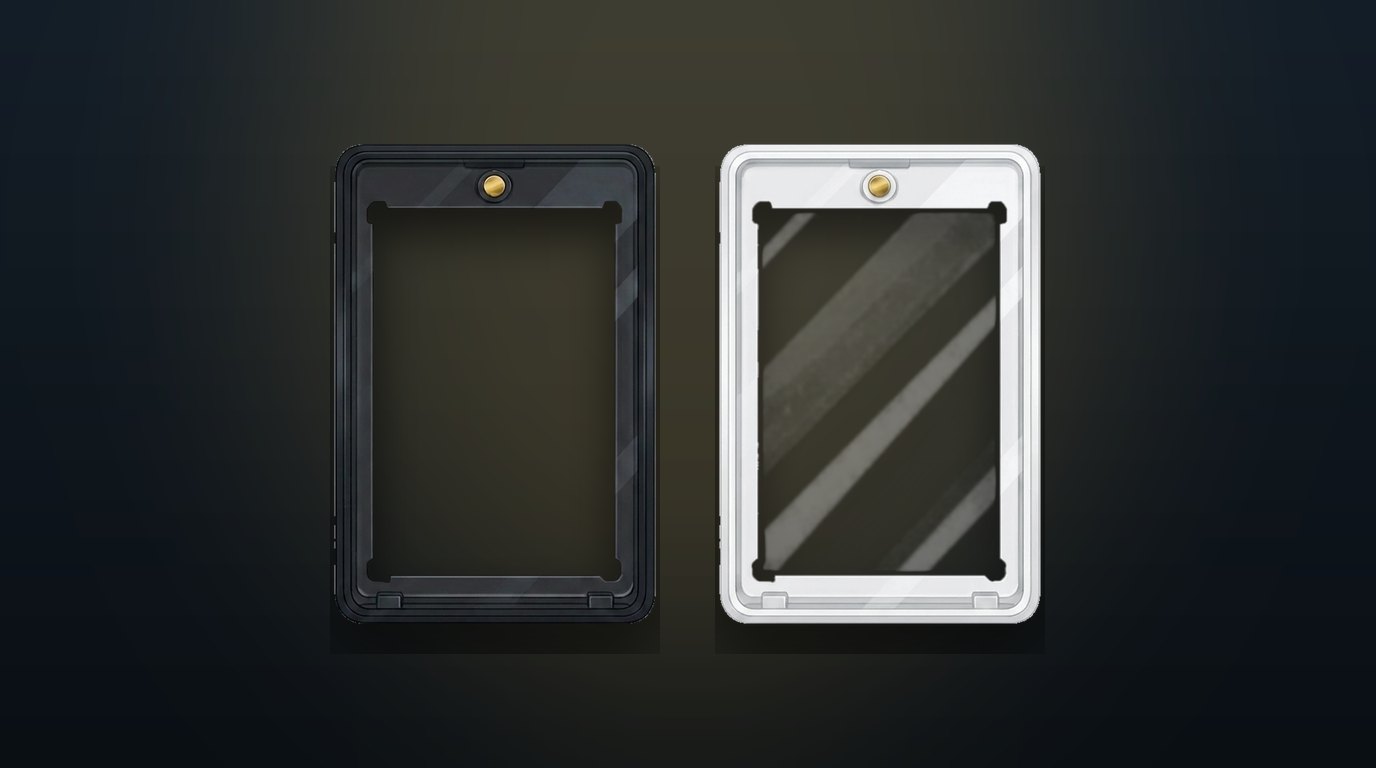
A curled card is not a lost card: it is usually a foil card that reacted to humidity. First identify the defect (soft curl, warp or crease), then apply the slow method: sleeve, rigid holder, flat under a light weight, in a stable room, and patience. The real risk is forcing it. From then on, keep your cards in stable air and hold the ones that matter between two rigid surfaces: that is exactly what a one-touch does, and it is the simplest way to display a beautiful Japanese card without watching it bend.
Frequently asked questions
Can a curled card become perfectly flat again?
Often yes, when the curl is light and recent: after a few days flat in a rigid holder, in a room with stable humidity, the bend decreases or disappears. An old or very strong curl may only partly ease. A crease never truly goes away.
Why do my commons stay flat but not my rare cards?
Because rare cards are often foil: the foil layer on the front barely reacts to humidity, unlike the paper back. That imbalance bends the card. Non-foil cards are more uniform and generally stay flat.
Can I use a very heavy book or a press to flatten a card?
A light, evenly spread weight on a protected card is enough and carries no risk. Strong or concentrated pressure can mark the surface, imprint the sleeve on the card or create a warp. Patience achieves more than force.
Does a one-touch really stop a card from curling?
It holds the card flat between two rigid surfaces, which greatly limits curling as long as the card stays inside. It does not cancel out an extreme environment, though. Keep it away from direct sunlight, radiators and damp rooms.
Read next
Authenticity and condition
Online card selling scams: spot the traps and buy safely
Online card selling scams: the 8 most common traps, the warning signs to watch for and a simple method to buy your cards safely.
November 21, 2026

Authenticity and condition
One Piece card centering: how to measure it and what it does to value
Centering affects a One Piece card's grade and price. How to measure it, how to read it on a listing photo, and when it barely matters at all.
November 21, 2026
Authenticity and condition
One Piece card sleeve size: the right fit and how to sleeve properly
One Piece cards measure about 63 × 88 mm: use standard or perfect fit sleeves, never small ones, and sleeve them without forcing. Here is how.
November 20, 2026