
One Piece card frame: how to choose one that protects and shows off
Published on November 23, 2026 · 7 min read

Key points
- A good One Piece card frame holds the card without pressing it, uses no glue or tape, and opens without tools so the card can be removed at any time.
- For a valuable card, a magnetic one-touch frame with double glass is the safest choice: it protects like a rigid case and displays like a frame.
- A One Piece card should stay in its sleeve inside the frame: the sleeve prevents direct contact with the glass and limits scratches.
- No frame replaces a good spot: a framed card keeps for years away from direct sunlight, heat sources and damp rooms.
You finally own the One Piece card you were after, a Luffy parallel, an alternate leader or a Japanese SEC, and you no longer want it sitting in a binder. You start looking for a One Piece card frame and find a confusing mix: mini photo frames, acrylic stands, one-touch cases, slab frames. Some make the card shine, others slowly damage it without you noticing.
The short answer: for a card that matters, choose a one-touch frame with a magnetic closure and double glass, keep the card sleeved inside, and save classic photo frames for cards with nothing at stake. This guide sets out the criteria to check, compares frame types in a table, then helps you pick the colour, the mounting and the location for a collector-grade display.
What types of frames exist for a One Piece card?
There are five main families. The classic photo frame, designed for paper prints and often the wrong size; the acrylic display, a block or stand placed on a shelf; the one-touch case, two rigid plates that clamp the card; the slab frame, made for the case of a graded card; and the display cabinet, which shows several cards behind one glass door.
They do not serve the same purpose. A photo frame decorates but protects poorly: the card slides around, floats in a mount, or gets pressed against the glass by a cardboard back. A one-touch protects very well, but a bare one-touch lying flat in a drawer shows nothing. The right choice combines both functions: the rigidity of a case and the presentation of a frame.
That is exactly what a magnetic aluminium one-touch frame does: the card is held between two panes, the metal frame provides the finish, and the magnets allow stacking, standing storage and wall mounting. The table below sums up the strengths and weaknesses of each option.
| Type of display | Card protection | Look on display | Wall mounting | Best for |
|---|---|---|---|---|
| Classic photo frame | Low, card often poorly held | Fair | Yes, with a nail or hook | Cards with no value, pure decoration |
| Acrylic display | Medium, depends on the closure | Good on a shelf | Rarely | Everyday card put forward |
| Bare one-touch | Good | Limited, flat or on a stand | No | Safe storage of a valuable card |
| Magnetic one-touch frame | Good, double glass | Very good | Yes, no drilling with a magnetic strip | Valuable card to display |
| Slab frame | Good, card already sealed | Very good | Depends on the model | PSA graded card |
| Display cabinet | Medium, depends on the cases inside | Good for a set | Depends on the furniture | Large collection with figures |

Which protection criteria should you check before buying a frame?
A frame is judged first by what it does to the card. A Japanese One Piece card has thin edges and a glossy surface, often foil on higher rarities: it dislikes pressure, rubbing, adhesive and swings in humidity. The frame must keep it still without squeezing it, and open easily the day you want the card back.
Be wary of vague product listings. The words card frame say nothing about how the card is held or how the frame closes. Ask yourself three questions: how is the card held, how does the frame close, and what touches its surface? Here is the checklist we use ourselves.
One last criterion is often overlooked: reversibility. A framed card may one day be sold, graded or simply moved. A frame that opens in two seconds, with no clips to remove and no back to peel off, will never put your card at risk.
- Hold: the card neither slides nor floats when you tilt the frame.
- No glue, no tape, no adhesive dots touching the card or its sleeve.
- Moderate pressure: the card is held flat, not crushed, which avoids marks and curling.
- Tool-free closure, ideally magnetic, so you never force the corners.
- Clear, clean glass, with no scratches or tinted reflections out of the box.
- A rigid frame, metal or thick plastic, that does not twist in your hand.
- A size that fits a sleeved card, without too much play.
Should you take the card out of its sleeve to frame it?
No. A card goes into its frame sleeved, inside the soft clear pocket that wraps it. The sleeve prevents direct contact between the card face and the glass, limits micro-scratches when you open the frame, and protects the edges while you handle it. On a foil or textured card, whose surface marks easily, it is an essential precaution.
Choose a snug, clean sleeve with no creases. A sleeve that is too big forms a fold you can see through the glass, and a yellowed or scratched one spoils the look. The routine is simple: slide the card into the sleeve, place it in the centre of the frame, close it. For extra protection, a tight perfect fit sleeve works too, as long as the frame accepts the added thickness.
The magnetic frame works in three steps: protect the card in a sleeve, stack the frames face to back with the magnets when you store them, then display them on a shelf or on the wall. This flexibility lets you rotate your display without ever taking the cards out.
Black or white frame: which one shows a card off best?
Colour is not a detail: it changes how the card reads. A black frame creates strong contrast, makes saturated colours and foil effects pop, and blends into a darker setting, a manga shelf or a gaming desk. It is the most versatile choice and works with almost every artwork.
A white frame gives a brighter, airier look. It suits light interiors, white walls and cards whose artwork is already pale, where a black frame would feel heavy. On a wall of several cards, it creates a lighter gallery effect.
Our advice: one colour per group. A wall where black and white alternate at random looks messy, while a consistent row makes the collection feel like a curated exhibition. If your decor is neutral, black is the safe bet; if the room is bright, white steps back and lets the card speak.

Raw card or PSA graded card: which frame should you choose?
If your card is ungraded, a standard one-touch frame is enough: it fits inside in its sleeve. Our magnetic aluminium frame, with double glass, in black or white, costs €24.80 each, and when you buy 2 the 3rd is free.
If your card has been graded and sealed in a PSA slab, it no longer fits a regular frame: the case is larger and thicker. You need a dedicated frame. Our PSA slab compatible version costs €34.80; it is sold empty and holds your slab without altering it. The slab already protects the card, so the frame is mainly there to display it and to line up your graded cards with the rest of the collection.
Do not get a card graded just to frame it: grading has a cost and a benefit that depend on the card, and a good frame already protects an ungraded card very well. The choice of frame follows the condition of the card, never the other way round.

How do you display several framed cards without drilling?
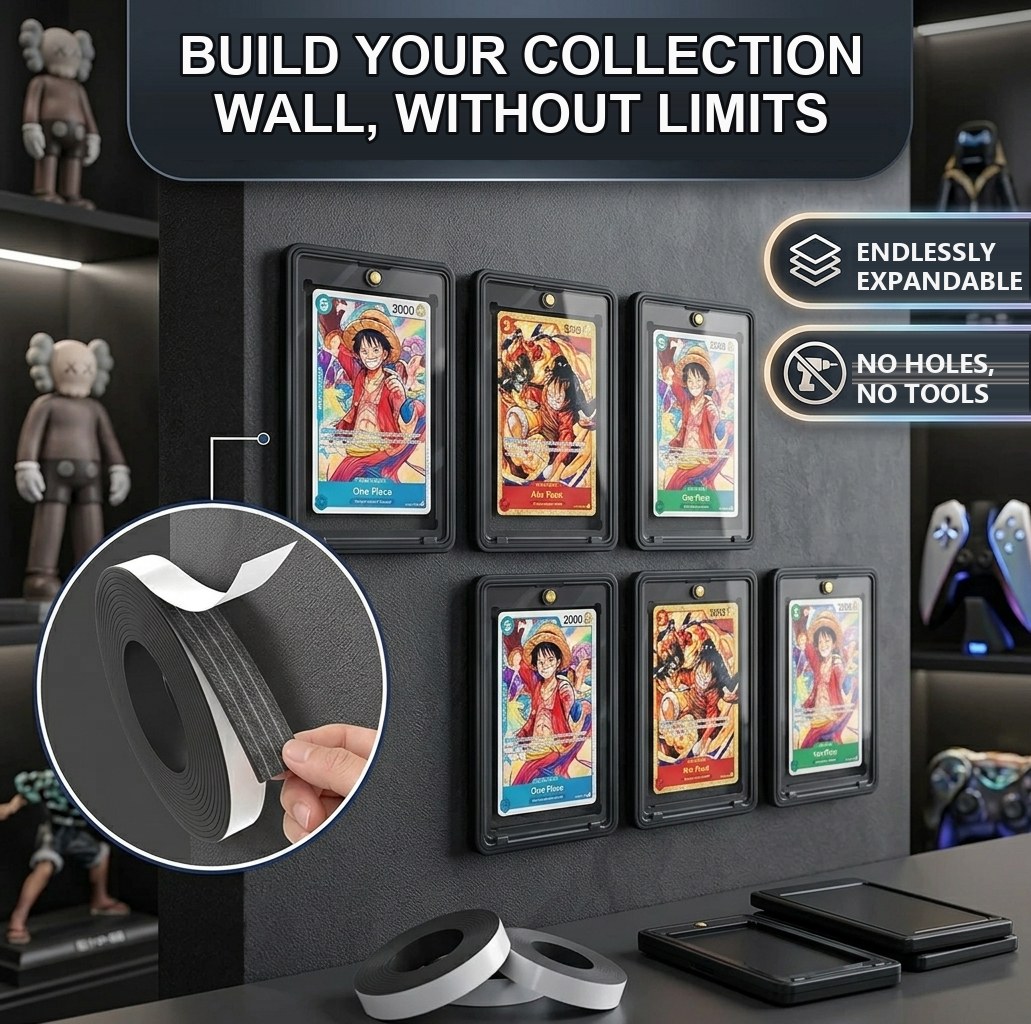
Once the first card is framed, the second follows quickly, then the third. The question becomes the whole display. Magnetic frames have a clear advantage here: they attach side by side to a self-adhesive magnetic strip stuck on the wall. No drilling, no nails, and you add, remove or rearrange cards in seconds.
The strip comes in 1 m for €15 and 3 m for €29. Stick it on a clean, dry, smooth and level surface, then place the frames. On a shelf, the frames stand upright like books or stack face to back thanks to the magnets. You can keep part of the collection on show and the rest tucked away, and rotate cards as your mood or new sets dictate.
For a polished result, think about composition: a horizontal line at eye level, cards grouped by character, crew or set, a single frame colour. A neat row of four cards has more impact than a dozen scattered ones.
Where should you place your frames, and what budget should you plan?
The best frame cannot make up for a bad spot. Avoid direct sunlight, which eventually fades inks, walls above a radiator and damp rooms such as a bathroom. Prefer an interior wall, indirect light or LED lighting that stays cool. Every now and then, take a close look: a sleeve that wrinkles or a card that starts to bend signals a humidity problem.
On budget, one frame costs €24.80, and the buy 2, get the 3rd free offer brings three frames to €49.60. Shipping for cards and frames is €4.20, free from €100, and you only pay shipping once per order. If you add one of our Japanese single cards, everything travels in the same parcel.
Finally, weigh the frame against the card it protects. For a card worth a few euros, a frame may seem a lot; for a parallel or a SEC you plan to keep for years, it guards against scratches, damaged corners and dust, while being real decoration.
For a One Piece card that matters, the verdict is clear: a magnetic one-touch frame with double glass, the card sleeved, no glue or pressure, placed away from sunlight and humidity. Classic photo frames are for decoration with nothing at stake, and slab frames for cards already graded. Next step: pick the card you want to highlight and the colour that suits your room, start with three frames to benefit from the offer and free shipping, then grow the wall at the pace of your collection.
Frequently asked questions
What size frame does a One Piece card need?
One Piece cards use the standard trading card size. A one-touch frame designed for that size holds the card in its sleeve. For a graded card you need a slab compatible frame, because the case is larger.
Does a frame protect a card from fading?
A frame protects against dust, scratches and knocks, but no glass should be seen as a complete shield against light. What really matters is location: no direct sunlight, indirect light only. That is what keeps colours intact over time.
Can you frame a card without a sleeve?
You can, but it is not advisable for a valuable card. The sleeve prevents direct contact with the glass and limits scratches when you open the frame. It costs very little and makes the card easier to handle.
How do you hang a card frame without drilling?
Use a self-adhesive magnetic strip: stick it on the wall, then place the magnetic frames side by side. It comes in 1 m for €15 and 3 m for €29. Frames come off and go back on without ever touching the card.
Read next

Collecting and displayNovember 25, 2026
One Piece Emperors cards: how to build a Yonko display in Japanese
Four Emperors One Piece cards: which Yonko lineup to pick, which Japanese versions to target and how to frame and hang the display without drilling.

Collecting and displayNovember 25, 2026
Ace, Sabo and Luffy card collection: how to build a Brothers trio
Ace, Sabo and Luffy card collection in Japanese: three ways to match the trio, the buying order, layout and framing that make it one set.

Collecting and displayNovember 24, 2026
Straw Hat crew collection: assembling all 10 members in Japanese cards
How to build a Straw Hat crew collection in Japanese cards: the common thread to pick, the buying order and the best way to display all ten members.