
One Piece Card Game sets list: every Japanese series, sorted and explained
OP, EB, PRB, ST and P: every Japanese One Piece Card Game set sorted by family, with what each one really brings to your collection.
Published on November 13, 20268 min read
Key points
- The Japanese One Piece Card Game is split into five product families: OP main boosters, EB Extra Boosters, PRB Premium Boosters, ST starter decks and P promotional cards.
- Main boosters are numbered in release order, from OP01 (Romance Dawn) to OP18 in the OPCG Gallery Japanese catalogue, and they form the backbone of the game.
- The code printed on every card, for example OP05 or ST10 followed by a card number, tells you its original set directly and lets you identify it without ambiguity in any language.
- For a collection, the set family matters less than the card itself: character, rarity (SR, SEC, L, SP), parallel version and condition decide how desirable a One Piece card is.
You want a clear picture of the Japanese One Piece Card Game sets: which codes exist, in what order they came out, and which ones actually matter for a collection. Between OP, EB, PRB, dozens of starter decks and promos, the naming system gets confusing fast, especially when you buy single cards and want to know exactly where each one comes from.
The answer comes down to one simple rule: the whole Japanese game falls into five families, and every card carries the code of its family and set number. Here is the complete list, OP01 to OP18, EB01 to EB05, PRB01 and PRB02, ST01 to ST36 and the P promos, followed by a method to pick the family that fits your goal: playing, opening, collecting or displaying.
In this article
- 1. What are the set families of the Japanese One Piece Card Game?
- 2. Main boosters: how to read the list from OP01 to OP18?
- 3. Extra Boosters and Premium Boosters: what are EB and PRB for?
- 4. Starter decks ST01 to ST36: do they belong in a collection?
- 5. P promo cards: a family of their own?
- 6. How do you know which set a card comes from?
- 7. Which set should you choose for your goal?
What are the set families of the Japanese One Piece Card Game?
Bandai organises the Japanese game into five families, each with a different role. Main boosters, coded OP, are the large numbered sets that introduce most new cards. Extra Boosters, coded EB, and Premium Boosters, coded PRB, are complementary releases. Starter decks, coded ST, are preconstructed decks. Finally, promotional cards carry the code P.
This split is not just paperwork. It tells you how the product is sold (random boosters or a box with fixed contents), who it is aimed at (new player, experienced player, collector) and how its cards then circulate on the singles market. A card pulled from a random booster simply does not have the same availability as a card included in every copy of a starter deck.
The table below sums up the five families as they appear in our Japanese catalogue. Keep it in mind: each following section covers one family in detail, then we look at how to read a card code and which family to favour depending on your budget and your goals.
| Family | Codes in our catalogue | Format | Main appeal |
|---|---|---|---|
| Main booster | OP01 to OP18 | Random boosters, also sold as 24-pack displays | New cards, high rarities, parallels |
| Extra Booster | EB01 to EB05 | Random boosters, complementary release | Focused theme, depending on the set |
| Premium Booster | PRB01, PRB02 | Random boosters, high-end positioning | Special finishes and versions |
| Starter deck | ST01 to ST36 | Deck with fixed contents | Start playing, accessible leader |
| Promo | P | Distributed outside boosters | Exclusive artwork, collector pieces |
Main boosters: how to read the list from OP01 to OP18?
Main boosters are numbered in release order: OP01 is the very first set of the game, Romance Dawn, and each new number follows the previous one. As of this article, our Japanese catalogue runs from OP01 to OP18. The number alone places a set in the history of the game, so there is no need to memorise titles, which vary between translations anyway.
Each Japanese main booster is sold as single packs or as a display of 24 boosters with 6 cards each. It covers the full rarity ladder: commons (C), uncommons (UC), rares (R), super rares (SR), secret rares (SEC), leaders (L), and depending on the set, SP cards or parallel versions with alternate artwork. Most of the cards collectors chase are born in this family.
To find your way around, think in blocks rather than titles. The first numbers laid the foundations of the game and carry heritage value, the middle numbers form the core of the catalogue, and the most recent numbers often go through a preorder phase before being widely available.
- OP01 to OP04: the first sets, which established the colours, the founding leaders and the rarity ladder.
- OP05 to OP10: the core of the catalogue, whose single cards are usually easy to find in Japan.
- OP11 to OP16: more recent sets, whose singles market is still settling.
- OP17 and OP18: the most recent numbers in our catalogue, worth following during preorder and release.
Extra Boosters and Premium Boosters: what are EB and PRB for?
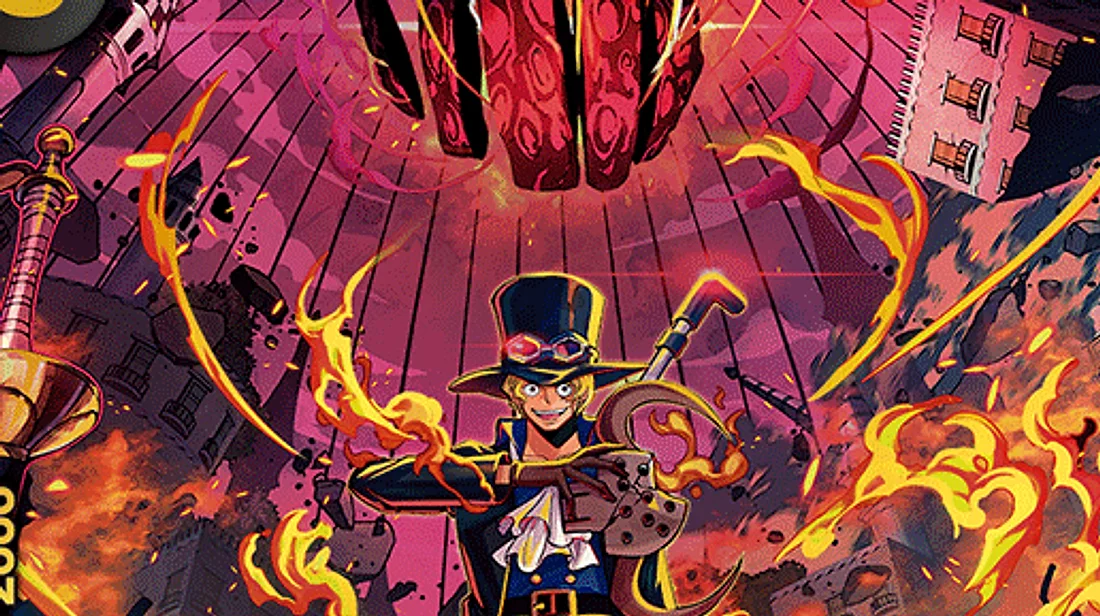
Extra Boosters, EB01 to EB05 in our catalogue, are complementary releases that slot in between main boosters. Usually more compact, they are built around a theme or a group of characters, and may offer alternate versions of cards you already know. They fully count in a collection: their cards carry their own EB code.
Premium Boosters, PRB01 and PRB02, play a different tune. Their positioning is high-end: the price per booster is generally higher, and the appeal lies in special finishes and special versions of cards. They speak to collectors more than to players trying to complete a deck as cheaply as possible.
The practical consequence for you: an EB or PRB card is neither minor nor a side issue. It is judged exactly like an OP card, on its character, rarity, version and condition. And when the same card exists in both a main set and a complementary release, check the code and version before buying, because prices can differ significantly.
Starter decks ST01 to ST36: do they belong in a collection?

Starter decks, ST01 to ST36 in our catalogue, are preconstructed decks with fixed contents. You know exactly what you are buying: a leader and a ready-to-play deck. They are the natural entry point to learn the game, or to get a leader and a colour without relying on booster luck.
For a collector, the appeal is more selective. Since every copy contains the same cards, starter deck cards are usually plentiful, and their single value generally stays modest. There are exceptions, linked to a highly sought-after character, a much-loved illustration or a starter deck that became hard to find over time, but they are not the rule.
Our advice is simple: buy a starter deck to play, or for a specific leader you like. Do not buy it thinking you are building a store of value. If you want a beautiful card of a character, the version pulled from a main booster, in high rarity or as a parallel, will almost always be the more relevant target.
P promo cards: a family of their own?

Promotional cards carry the code P and do not come from a set in the usual sense. They are distributed through other channels: events, tournaments, commercial campaigns, merchandise or bonuses attached to a purchase. That is why they get their own line in the list, even though they are fully part of the game and play like any other card.
From a collecting standpoint, the P family is mixed. Some promos were widely distributed and remain easy to get, others come from restricted channels and become sought after, particularly when they feature exclusive artwork of a popular character. There is no single rule: each promo is judged on its distribution, its character and its condition.
Japanese promos hold special appeal for a European collector, because some only circulate in Japan. If an illustration catches your eye, buying the single from a source that sources locally is often the most direct way to get it, rather than waiting for a hypothetical European release.
How do you know which set a card comes from?

Every One Piece Card Game card carries a printed code that shows its origin. Most follow the same logic: a family and set number code, then a card number. OP05 points to the fifth main set, EB02 to the second Extra Booster, ST10 to the tenth starter deck. Promos carry the prefix P followed by their number.
This code is your best tool, far more reliable than the set name, which changes across languages and translations. It lets you find a specific card in a catalogue, compare offers and check that a listing really matches the version you want. For parallel versions, the code is often the same as the base version: the artwork and the rarity marking then make the difference.
Before buying a single card, always run the checks below. They take a minute and prevent the most expensive mistake, paying the price of a rare version and receiving the common one.
- Note the full card code: family, set number and card number.
- Check the stated rarity: C, UC, R, SR, SEC, L, SP or P.
- Compare the artwork with the version you want, especially for a parallel.
- Check the stated condition: A, A-, B or C.
- Confirm the card is Japanese if that is the version you are after.
Which set should you choose for your goal?
There is no best set in absolute terms, only the right family for your goal. If you want to play, start with a starter deck in the colour that appeals to you, then complete it with single cards. If you want to open boosters for the joy of discovery, a main set booster or display remains the reference experience.
If you collect a character, forget the set logic: list all their versions across every family, and choose the one whose artwork and rarity speak to you. Buying singles is then the most efficient method, because you pay for the card you want rather than the luck of a pull. Our Japanese single cards are bought in Japan on order, with a stated condition from A to C.
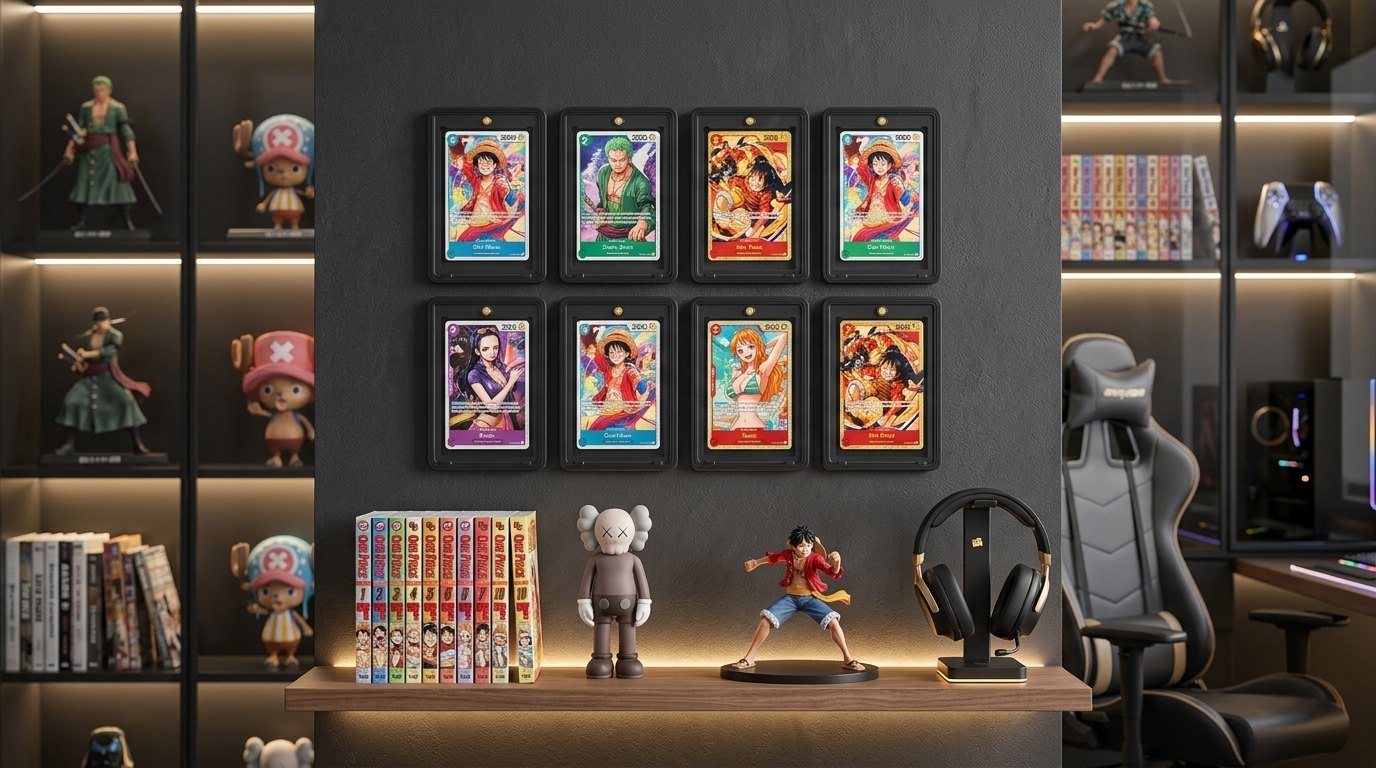
Finally, if you want to display, think about the whole: one card per landmark set, one leader per colour or every version of the same character all make striking walls. Our one-touch magnetic frame with double glass protects each card and fixes to the wall without drilling thanks to the adhesive magnetic strip. And if you prefer surprises, the Mystery Box offers a draw of real Japanese cards.
The list of Japanese One Piece Card Game sets reads as five families: OP01 to OP18 for main boosters, EB01 to EB05 plus PRB01 and PRB02 for complementary releases, ST01 to ST36 for starter decks, and the P promos. Above all, remember two things: the code printed on the card is the reference, and value depends on the card before it depends on the set. Your next concrete step: pick a character or a set you love, note the codes of the versions that interest you, then browse our Japanese single cards to find yours.
Frequently asked questions
How many One Piece Card Game sets are there in Japan?
Our Japanese catalogue includes main boosters OP01 to OP18, Extra Boosters EB01 to EB05, Premium Boosters PRB01 and PRB02, starter decks ST01 to ST36, plus P promotional cards. The list grows regularly, because new sets are released in Japan first.
What is the first One Piece Card Game set?
The first main set is OP01, Romance Dawn. It laid the foundations of the game, its colours and its first leaders. It remains a reference for many collectors.
What is the difference between an OP set and an EB set?
OP sets are the numbered main boosters, which bring most new cards. EB sets are complementary Extra Boosters, usually more compact and built around a theme. In both cases, a card is judged on its character, rarity, version and condition.
Are Japanese sets the same as English ones?
Sets come out in Japan first, and the English version follows with a delay. Card codes generally stay the same across languages, which makes it easy to link them. Dates and the contents of some products can still differ, so always check the code and the language before buying.
Read next
 Sets and releases
Japanese EB05 display: what's inside and who it's for at 129 €
November 25, 20267 min read
Japanese EB05 display at 129 €: what an Extra Booster is, 10 named cards with single prices, and the verdict: box or chosen singles.
 Sets and releases
Japanese OP17 display: what do its 24 boosters hold for 129 €?
November 25, 20267 min read
Japanese OP17 display at 129 €: 24 boosters, 144 cards, Leaders and secret rares named by code, and when buying singles is the better call.
 Sets and releases
One Piece Card Game Japan release schedule: how to read it and plan ahead
November 13, 20267 min read
One Piece Card Game Japan release schedule: how to read it, how far ahead of Europe Japan runs, when to preorder and what reprints change.